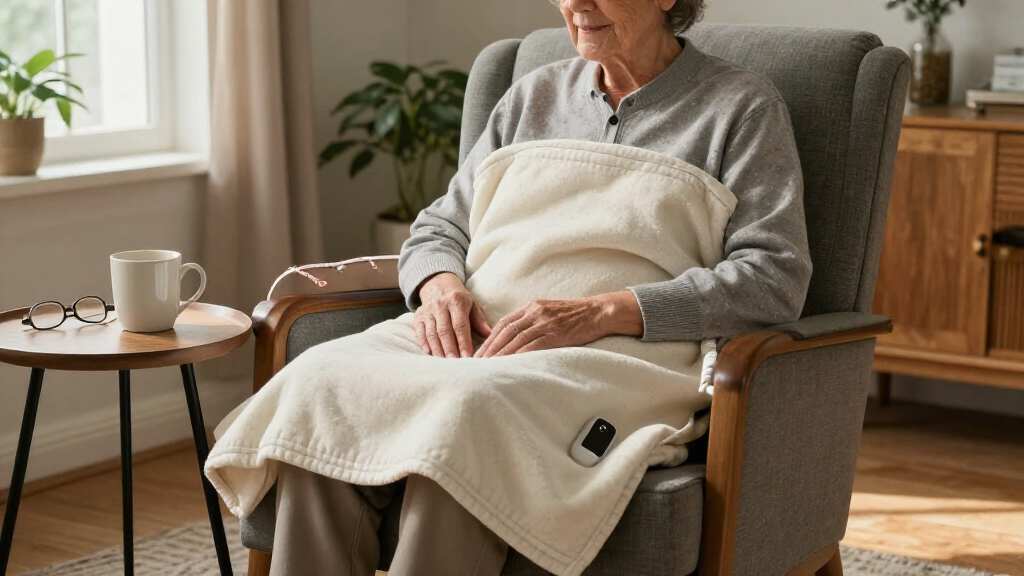

This guide helps a senior, family member, or caregiver select and use an electric blanket with practical safety checks. You will check whether the blanket fits the bed and the user’s needs, inspect it before use, set its controls, and confirm that the person can operate it or has reliable help. The guide is for beginners and takes about 30-60 minutes for selection and setup, plus an evening to check comfort. An electric blanket may not be suitable for someone who cannot reliably feel heat, communicate discomfort, or switch the controls off; speak with a healthcare professional when those abilities or a medical condition raise concerns.

Turn quiet afternoons into listening time
- Thousands of audiobooks, podcasts and originals
- Listen on your phone, tablet or Echo — also offline
- Cancel anytime

Bedsure Heated Blanket Throw Blanket with Preheat Function (50 x 60 inches, Grey)
- ✔ Size: 50 x 60 inches
- ✔ Form: Heated throw blanket
- ✔ Heat levels: 6

greenoak Heated Blanket Electric Throw (50 x 60 inches, Misty Grey)
- ✔ Size: 50 x 60 inches
- ✔ Form: Electric throw blanket
- ✔ Heat levels: 10

Bedsure GentleSoft Heated Blanket Throw (50 x 60 inches, Grey)
- ✔ Size: 50 x 60 inches
- ✔ Form: Heated throw blanket
- ✔ Heat levels: 6
Difficulty: Beginner | Time: 30-60 minutes for selection and setup; allow one evening to confirm comfort
What You’ll Need
Tools & Materials:
- Electric blanket with its original controller and instructions
- Bed or chair where the blanket will be used
- Access to a wall outlet recommended by the manufacturer
- Flashlight for inspecting the blanket and cable
- Phone or another way to contact a caregiver, if needed
Knowledge:
- Basic ability to read the product label and operating instructions
- Knowledge of whether the user can feel heat, move the blanket, and operate the control
- Caregiver support if the user has memory, vision, dexterity, or mobility limitations
Choose a blanket certified to applicable electrical safety standards in your country, with a label, intact controller, and clear instructions. Follow the manufacturer’s rules for washing, storage, bed placement, and use. Do not use a blanket that is damaged, recalled, or missing its instructions. Ask a clinician before use if the person has reduced heat sensation, poor circulation, diabetes-related nerve damage, fragile skin, or another condition that may affect their ability to notice or respond to heat. A clinician can advise on individual risks; this guide does not replace that advice.
Bedsure Heated Blanket Throw Blanket with Preheat Function (50 x 60 inches, Grey)
For a senior who wants a throw for the sofa or a favorite chair, this Bedsure is the most balanced choice in our lineup. Its preheat function is the useful differentiator: instead of starting with a cold blanket and manually changing settings later, the supplied routine begins at Level 6 for two hours and then drops to Level 4 for six hours. That may make ongoing use more straightforward for someone who prefers a planned warm-up, although a caregiver should confirm the controls are understandable to the intended user.Six heat levels offer a simpler range than greenoak’s ten, while still allowing adjustment. Its stated ETL and FCC certifications and 8-hour default shutoff also make the safety information more specific than the details supplied for greenoak. The 220 GSM flannel face and 200 GSM sherpa backing make it soft on both sides; compared with GentleSoft, it has less explicitly substantial fabric, but the two share a similar size and core control features.The compromise is coverage: 50 by 60 inches warms one person rather than a full bed, and a timed shutoff means it should not be treated as uninterrupted overnight heat. The listing describes machine care, but users still need to disconnect and follow the manual’s instructions. This is our lead for a senior who wants a versatile throw and a guided warm-up, not for someone who needs broad bed coverage or cannot manage an electric cord safely.
Pros:
- Preheat routine transitions from higher to lower heat without requiring repeated adjustments.
- Six heat levels and six timer choices, including a 10-hour selection.
- Listing states ETL and FCC certification and an 8-hour default automatic shutoff.
- Flannel and sherpa sides provide a soft throw when the heat is off.
Cons:
- 50-by-60-inch throw size does not cover a full bed or reliably warm two people.
- Six heat levels provide fewer adjustment steps than greenoak’s ten.
- A preset sequence and wired controller may still be confusing for users with cognitive or dexterity limitations.
Best for: A senior who uses a chair or sofa, wants a preheat routine, and benefits from a moderate number of heat settings plus a documented automatic shutoff.
Not ideal for: Anyone needing a full-bed blanket, a wireless option, or a product whose control panel has been verified as accessible for low vision or limited dexterity.
Bottom line: We recommend this as the most balanced senior-friendly throw in the group when its size, cord, and controls suit the user.
“We recommend this as the most balanced senior-friendly throw in the group when its size, cord, and controls suit the user.”
greenoak Heated Blanket Electric Throw (50 x 60 inches, Misty Grey)
Greenoak is the pick for buyers who care most about adjusting warmth in small increments. It lists ten heat levels across a stated range of 86°F to 113°F, compared with six levels on both Bedsure throws. That extra granularity may help someone find a comfortable setting without jumping between larger steps, but it does not automatically make the controls easier to use. If a senior has trouble reading small labels or remembering settings, a simpler control scheme may be preferable.The throw combines flannel and sherpa and is described as lightweight for use in a chair, at a desk, or on a couch. Five timer choices run from one to eight hours. Unlike the Bedsure options, the supplied details do not identify a third-party certification or a preheat feature, and the care guidance is less convenient: machine washing is mentioned, but machine drying is specifically discouraged. The product also tells users to avoid bending or tangling wires, avoid uneven surfaces, and unplug when not in use, so the setup and storage routine deserves attention.This is not necessarily a reason to rule it out; it is a reason to compare documentation carefully. For a senior who wants more temperature steps and can follow the care and use instructions, greenoak may suit a favorite chair. For a buyer prioritizing a preheat sequence and stated ETL/FCC certification, Bedsure Heated Blanket is the more clearly documented option. As with every throw here, its dimensions are not meant to warm an entire bed.
Pros:
- Ten heat levels offer more adjustment steps than either Bedsure model.
- Stated temperature range is 86°F to 113°F.
- Five timer options include automatic shutoff periods from one to eight hours.
- Flannel-and-sherpa throw is described as lightweight and suitable for chair or couch use.
Cons:
- Supplied product details do not name a third-party safety certification.
- Instructions caution against wire bending, tangling, and uneven surfaces.
- Machine drying is discouraged, adding a care limitation compared with a simple wash-and-dry routine.
Best for: A senior or caregiver who values many temperature increments for seated use and can follow the blanket’s cord, washing, drying, and unplugging instructions.
Not ideal for: Buyers who prioritize a stated third-party certification, a preheat routine, machine-dryer convenience, or especially simple controls.
Bottom line: Choose greenoak for its ten heat steps only if its less extensive safety documentation and more cautious care routine fit your needs.
“Choose greenoak for its ten heat steps only if its less extensive safety documentation and more cautious care routine fit your needs.”
Bedsure GentleSoft Heated Blanket Throw (50 x 60 inches, Grey)
GentleSoft makes the most sense when the fabric itself is a deciding factor. Its ribbed flannel weave, 240 GSM flannel top, and 200 GSM sherpa backing give it a more substantial, textured feel than the standard Bedsure throw’s listed 220 GSM flannel face. The product information also identifies it as heavyweight, which may appeal to a senior who wants a cozy layer while sitting or napping. A heavier blanket can be less convenient to reposition, however, particularly for someone with limited strength.Its operating features largely match our overall pick: six heat levels, six timer choices, preheat, and an 8-hour default shutoff are described, along with stated ETL and FCC certification. So the choice between the two Bedsure models is mainly about feel and intended use, not a major difference in controls. Compared with greenoak, GentleSoft has fewer heat levels but more specific certification information in the supplied description and an identified machine-washable care claim.The 50-by-60-inch dimensions still limit it to throw use, and the product’s fabric emphasis does not solve accessibility questions around the controller. Its heavier construction may be a plus for a stationary nap, but a drawback for anyone who needs a light blanket that is easy to lift, fold, or move from room to room. Buyers should also follow the current care instructions and disconnect the controller before washing as directed by the manual.
Pros:
- 240 GSM flannel top and 200 GSM sherpa backing provide a plush, textured feel.
- Six heat levels, preheat, and six timer selections mirror the useful controls of the standard Bedsure option.
- Listing states ETL and FCC certification and an 8-hour default automatic shutoff.
- Machine washable according to the supplied product information.
Cons:
- Heavier-feeling construction may be harder to reposition for users with reduced strength.
- Six heat levels offer fewer increments than greenoak’s ten.
- Throw dimensions are not a substitute for a full-size bed blanket.
Best for: A senior who wants a soft, ribbed, more substantial-feeling throw for a chair, sofa, or nap and prefers Bedsure’s stated control and safety features.
Not ideal for: Anyone who finds heavier bedding difficult to lift, wants the broadest temperature range, or needs coverage beyond a 50-by-60-inch throw.
Bottom line: Pick GentleSoft over the standard Bedsure throw when its ribbed, heavier fabric is worth more to you than a lighter feel.
“Pick GentleSoft over the standard Bedsure throw when its ribbed, heavier fabric is worth more to you than a lighter feel.”
As an Amazon Associate we earn from qualifying purchases.
Before You Start
Check the user’s ability to operate the controller and respond to warmth before putting the blanket into service. Older adults can have different levels of sensation, dexterity, vision, memory, and mobility, so age alone does not determine whether an electric blanket is appropriate. If the person cannot reliably notice overheating or turn the blanket off, do not leave them using it unattended. Arrange caregiver supervision or choose a non-electric warming option, and ask a healthcare professional for advice when health conditions may affect heat safety.
Read the manual before connecting the blanket. Product designs differ: some are made to go over the person, while others are designed to sit beneath them. Use only the placement stated by the manufacturer. Do not put an electric blanket on an adjustable bed, recliner, or other moving surface unless the manual specifically allows it. Keep pets from chewing or clawing the fabric and cables.
Step-by-Step Instructions
Step 1: Match the blanket to the user and bed
Measure the mattress or chair area and choose a blanket designed for that size and use. Check that its controls are easy for the user or caregiver to see, reach, and operate. Look for a clear temperature range, an automatic shutoff if available, and washing instructions the household can follow. If the user has limited sensation, memory, or hand strength, discuss suitability with a clinician and plan who will control the blanket.
Tip: Do not buy a blanket based only on a low price or a general claim that it is suitable for seniors. Check the product label, safety certification, manual, and any recall notices.
Check: The blanket is intended for the bed or chair, its size fits without excess fabric bunching, and the planned user can control it or has a named caregiver who will do so.
Step 2: Inspect the blanket and controller
Unplug the blanket before inspecting it. Spread it flat in good light and check both sides for holes, scorch marks, dampness, loose stitching, exposed wires, or crushed and kinked areas. Examine the controller, plug, and cable for cracks, fraying, discoloration, or loose connections. Confirm that the blanket and controller are the matching parts specified by the manufacturer.
Tip: Do not test or use a blanket with any damage, a burning smell, a history of overheating, or a controller that does not belong to that model. Replace it or contact the manufacturer; do not patch wires or substitute a controller.
Check: The fabric, wiring, plug, and controller look intact and dry, with no signs of heat damage or alteration.
Step 3: Place the blanket as instructed
Lay the blanket in the exact position shown in its manual: over or under the user, as the model requires. Smooth it flat, keep the heating area free of folds and bunches, and make sure no part is tucked tightly around the mattress unless the instructions permit it. Keep the cable and controller clear of walkways, bed mechanisms, and places where they could be pinched, pulled, or caught.
Tip: Never fold, bunch, or pin the blanket in a way that traps heat. Do not place another heavy blanket, mattress topper, or cushion over it unless the manufacturer says that arrangement is safe.
Check: The blanket lies flat in its approved position, the cable is not strained or trapped, and the user can get in and out without stepping over it.
Step 4: Connect the controller safely
Connect the controller to the blanket using the manufacturer’s method, then plug the unit directly into an appropriate wall outlet unless the manual states otherwise. Keep the plug and controller dry and uncovered. Do not use an extension cord or power strip unless the manufacturer explicitly permits it. Position the controller where the user can reach it without stretching or leaning dangerously; arrange caregiver control if the user cannot operate it safely.
Tip: Unplug the blanket before attaching or removing a detachable controller. Do not run the cable beneath a mattress, rug, or furniture where it can be crushed.
Check: All connections are secure, the cable is visible and undamaged, and the controller can be reached safely by the person responsible for switching it off.
Step 5: Test the controls and choose a low setting
Follow the manual to switch on the blanket and select its lowest useful setting. Confirm that the indicator lights or display behave as described. Warm the bed before the person settles in only if the manufacturer permits preheating, and switch to the recommended setting afterward. Do not rely on touch alone to judge internal electrical safety, and stop immediately if the blanket smells scorched, sparks, makes unusual sounds, or heats unevenly.
Tip: Do not place the controller under bedding or leave it where it could be accidentally pressed. Avoid using a high setting to compensate for a cold room; adjust room temperature or bedding instead.
Check: The control responds normally, the blanket warms as described without unusual smell or hot spots, and the setting remains low and comfortable.
Step 6: Check comfort and supervision
Ask the user whether the warmth feels comfortable, and check their skin and bedding for excessive heat, redness, or discomfort. Repeat the check after the period recommended by the manual and before the user falls asleep. Follow the product’s rules about overnight use; never assume a blanket is safe to leave on all night because it has an automatic shutoff. If the person cannot notice or report discomfort, have a caregiver remain responsible for monitoring and switching it off.
Tip: Stop use if the user reports burning, tingling, itching, or unusual warmth, or if skin becomes red. Turn the blanket off, unplug it when safe, and seek medical advice for a skin injury.
Check: The user is comfortable, there are no signs of overheating, and a capable person knows how to switch the blanket off and disconnect it.
Step 7: Switch off, unplug, and store it correctly
Turn the blanket off after use or at the time specified by the manual. Unplug it before cleaning, moving, or storing it, and let it cool. Clean it only by the method the manufacturer allows; some models require removing the controller before washing. Dry it fully before reconnecting. Store it loosely without tight folds or heavy objects on top, and check it again before the next season of use.
Tip: Do not wash, dry-clean, iron, or tumble-dry the blanket unless its instructions expressly allow that method.
Check: The blanket is switched off and disconnected when not in use, fully dry before storage, and kept without sharp creases or heavy pressure.
Common Mistakes to Avoid
- Using a blanket despite reduced heat sensation or inability to report discomfort. — Check the person’s ability to feel warmth and control the device first. Ask a clinician about relevant conditions, and arrange supervision or choose another warming method when the person cannot respond reliably.
- Folding, bunching, or tightly tucking the blanket. — Lay it flat in the position shown in the manual. Keep it clear of heavy bedding and do not trap it beneath a mattress or furniture.
- Using a damaged cable, incompatible controller, or improvised repair. — Inspect the whole unit before use and use only its specified controller. Stop using damaged equipment; contact the manufacturer or replace the blanket.
- Assuming automatic shutoff makes overnight use safe for every user. — Follow the manual’s rules for sleep and shutoff. Consider the user’s ability to feel heat, wake, and operate controls; use caregiver monitoring when needed.
Troubleshooting
Problem: The blanket does not warm up or the controller shows an error.
Solution:
Switch it off and unplug it. Check the manual for the meaning of the display or indicator, and verify that the controller is connected correctly while the unit remains unplugged. Do not open the controller or attempt a wiring repair. If the error remains, stop using the blanket and contact the manufacturer or retailer.
Problem: One area feels much hotter than the rest, or the blanket smells scorched.
Solution:
Switch it off and unplug it if you can do so safely. Move the user away from the hot area and stop using the blanket. Do not reconnect it to test it. Check for visible damage only after it has cooled, then contact the manufacturer or replace it; seek medical help for a burn or skin injury.
Problem: The cable or controller gets trapped or is difficult for the user to reach.
Solution:
Switch the unit off and unplug it before repositioning anything. Move the controller to a reachable, dry location and route the cable away from the mattress edge, moving bed parts, and walking path. If the cable cannot remain clear without stretching or pinching, discontinue use in that setup.
Problem: The user feels too warm, develops skin redness, or cannot explain how they feel.
Solution:
Turn the blanket off and remove the heat source. Check the skin and allow the person to cool comfortably. Do not restart it until the cause is clear and the user can be monitored safely. Seek medical advice for persistent redness, pain, blistering, or any burn.
What Success Looks Like
The setup is ready for use when the blanket is an appropriate model for the bed and user, has no visible damage, lies flat in its approved position, and connects to the matching controller as the manual directs. The control is reachable by a capable user or caregiver, the cable is not pinched or a trip hazard, and the lowest useful setting produces comfortable warmth without unusual odor, uneven hot spots, or skin redness. The person responsible for use knows when to switch it off, how to unplug it, and whom to contact if the blanket behaves abnormally.
Next Steps
Check the blanket, cable, and controller before each use, and stop using the unit if you notice damage, unusual heat, an odor, or a control fault. Review the manual before washing or storing it, and repeat the suitability check if the user’s sensation, memory, mobility, or health changes. Keep the model and manufacturer details so you can check for recalls or request approved replacement parts. If the user cannot safely operate the blanket or recognize discomfort, ask a healthcare professional about other ways to keep them warm.
Frequently Asked Questions
Can a senior use an electric blanket overnight?
It depends on the blanket’s instructions and the user’s ability to feel heat, wake, and operate the controls. Follow the manual’s overnight-use rules; do not assume an automatic shutoff makes overnight use suitable for everyone. Ask a clinician if a health condition affects sensation or circulation.
Can someone with diabetes use an electric blanket?
Diabetes can affect heat sensation, especially when nerve damage is present, which may make it harder to notice overheating. Ask the person’s healthcare professional before use if sensation is reduced or uncertain. Do not leave the person unattended if they cannot reliably detect and respond to heat.
Should the electric blanket go over or under the person?
Use it only in the position specified for that model. Some blankets are designed to lie over the person and others beneath them. Using a model in the wrong position can trap heat or damage the wiring.
Can I wash an electric blanket?
Only if the manufacturer allows it and you follow the exact cleaning instructions. Unplug the unit first, remove a detachable controller only as directed, and let the blanket dry fully before reconnecting it. Never guess about machine washing or drying.
What should I do if the blanket stops working or heats unevenly?
Switch it off and unplug it. Check the manual for a controller error, but do not open the unit, repair wiring, or test it again if you notice a hot spot, burning smell, or visible damage. Contact the manufacturer or replace the blanket.