
TL;DR

Turn quiet afternoons into listening time
- Thousands of audiobooks, podcasts and originals
- Listen on your phone, tablet or Echo — also offline
- Cancel anytime
An easy-reach kitchen puts everyday dishes, foods, and tools within the user’s comfortable reach, keeps heavy items low and stable, and leaves clear paths between work areas. Start by reorganizing one routine task, such as making breakfast, then consider drawers, pull-outs, better lighting, or professional advice if the layout still creates difficulty.
The mug you use every morning shouldn’t require a stretch, a wobbling step stool, or someone else’s help. In an easy-reach kitchen, the things you use most often sit where you can reach and return them with confidence. The room still looks and feels like your kitchen; it simply works better for the people who cook in it.
This guide shows you how to organize everyday items, reduce bending and overhead lifting, and make room for safer movement. You’ll find practical changes you can try before considering a remodel, plus ideas for work areas, seated use, and shared kitchens. Easy reach is personal: what feels comfortable for one person may be awkward for another, so your own routines are the best place to start.
Put everyday plates, foods, and utensils within the user’s comfortable reach; no one storage height suits everyone.
Keep heavy cookware low, stable, and close to where you cook, and avoid routine overhead lifting.
Try cabinet rearrangement and clear work zones before buying storage hardware or planning a remodel.
Check that pull-outs are stable, smooth, and rated for the items you plan to store.
Clear walkways, secure or remove loose rugs, and improve task lighting while remembering that these changes do not remove every risk.
A practical home guide · Universal design
Setting Up an Easy-Reach Kitchen
Bring everyday dishes, foods, and tools into a comfortable reach. Keep heavy items low and stable, clear the routes between work areas, and begin with one routine before considering new hardware or a remodel.
At a glance
Five changes that make a difference
A few thoughtful placements can make daily tasks easier to follow. Start small, then adjust based on what feels awkward in practice.
There is no single correct shelf height. Store items where the person using them can reach and return them with confidence.
Put everyday plates, foods, and utensils within the user’s comfortable reach.
Keep heavy cookware low, stable, and near the place where it is used.
Try rearranging cabinets and clearing work zones before buying hardware.
Make sure pull-outs glide smoothly and safely support their intended load.
Clear routes, secure loose rugs, and improve task lighting to support safer movement.
Set up by task
Build a kitchen around real routines
Notice what you reach for, where you stand, and which movement feels difficult. Keep related items close together.
Make breakfast easier
Put mugs, tea or coffee, cereal, and utensils together on a reachable shelf. Keep a clear surface for the toaster or kettle.
Try it: move one routine’s items as a group.Cut down on carrying
Store plates near the dishwasher, prep tools by the work surface, and cooking tools near the cooktop. Keep a safe place ready for a hot pan.
Try it: map breakfast, prep, cooking, and cleanup.Make room for each person
One person’s best shelf may be awkward for another. Give household members accessible spots for the items they use every day.
Try it: ask each user what feels comfortable.Choose a routine
Start with a task such as making tea and toast.
Notice the effort
Spot each stretch, bend, twist, or extra trip.
Move and group
Bring daily items together in a comfortable place.
Try it for days
Adjust if anything remains awkward to reach.
Make storage work
Bring deep-cabinet items into view
Choose storage aids to solve a real access problem. A simple rearrangement may be all the space needs.
Bring items forward
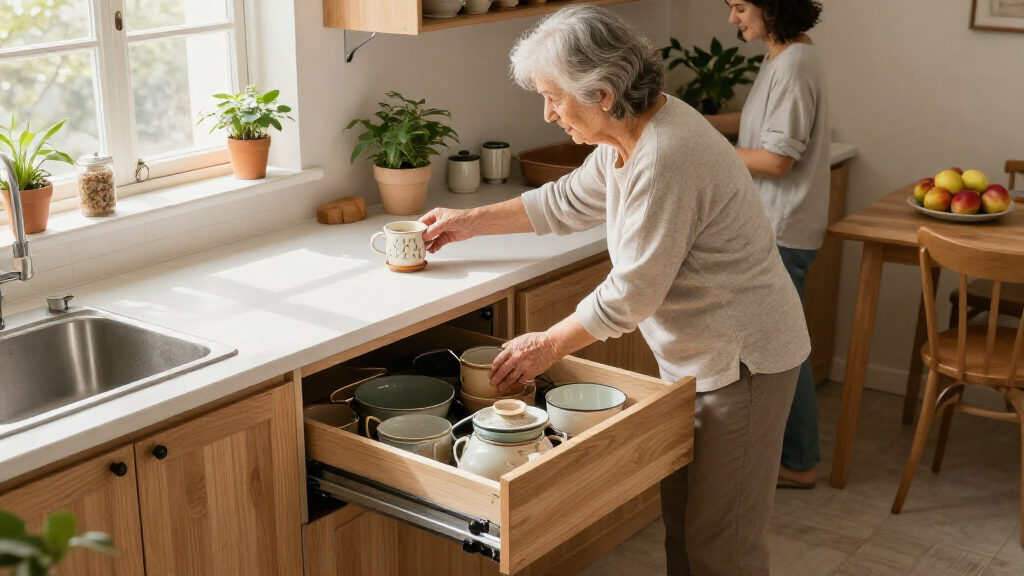
Drawers and pull-out shelves can reduce deep reaching. Check opening clearance, stability, and weight limits before loading them.
Best for: jars, cookware, and lower cabinets.See what is stored
A turntable can make oils or spices easier to find. Keep similar items together and leave space so containers are easy to return.
Best for: small items in crowded cupboards.Make essentials visible
Readable labels and clear containers help people find everyday foods without rummaging through a stack or reaching to the back.
Best for: pantry staples on an accessible shelf.Hardware varies in cost, installation needs, reliability, and load rating. Start with a small change; consider pull-down or motorized systems only when they suit the person, cabinet, and intended load.
A practical priority scale
Place items by frequency and weight
Use this visual as a planning cue, not a measurement standard. Comfort and safe handling vary from person to person.
Keep heavy items where they can be lifted close to the body without reaching overhead. A step stool is not a substitute for accessible storage, especially when balance is a concern.
Before you buy or remodel
A short safety and access check
Clear paths and thoughtful placement support safer movement, but they cannot remove every risk. Check the whole task, including carrying and setting items down.
Reach: Can daily-use items be taken out and returned without leaning or stretching?
Stability: Are drawers and pull-outs steady, smooth, and rated for their intended load?
Movement: Are routes and work areas clear, with loose rugs secured or removed?
Visibility: Is task lighting good, and are appliance controls visible and reachable?
Hot items: Are oven mitts close by and a clear landing spot ready near the oven?
Seated use: Would a stable seat, knee space, or reachable controls help with food preparation?
Common questions
Keep the first changes simple
Small adjustments can reveal what the kitchen needs before you invest in new hardware or a larger alteration.
Question 01
What should I move first?
Start with the daily-use items for one familiar task. Group them where the person can reach them comfortably, then try the new arrangement.
Question 02
Do I need a remodel?
Often, no. Rearranging shelves and clearing counters may help. Consider more involved changes only if a specific access difficulty remains.
Question 03
Are pull-outs always the answer?
No. Check the cabinet, opening space, ease of operation, and load rating. An organizer, turntable, or simple rearrangement may fit better.
Question 04
When should I ask for help?
An occupational therapist or qualified kitchen designer can help assess tasks and space when individual mobility needs make choices difficult.
Trace the routine
From reach to return
Make the whole task easier to follow: find what you need, use it safely, and put it back without an awkward movement.
Find
Visible, grouped everyday essentials.
Prepare
Tools close to a clear work surface.
Move safely
Clear paths and short carries.
Return
Stable storage that is easy to reach.
Start with the items you reach for every day
Setting up an easy-reach kitchen starts by putting daily-use dishes, foods, and tools within the person’s comfortable reach. The right shelf depends on who uses it; there is no single height that suits every body, posture, or mobility level. Keep rarely used items higher or lower, where reaching for them is less frequent.
Begin with a familiar routine, such as making tea and toast. A caregiver and an older adult might notice that the mugs sit above the fridge, tea bags are across the room, and the toaster crowds the counter. Moving those items together to a reachable shelf and a clear work surface can make breakfast feel less like a scavenger hunt.
Take one cabinet at a time and sort its contents by how often you use them. Place everyday plates, bowls, glasses, cereal, and utensils where you can retrieve them without leaning or stretching. If you share the kitchen, give each person an accessible spot for their own daily essentials; one person’s best shelf may be inconvenient for another.
Heavy items deserve special attention. Keep a full kettle, large mixing bowl, or favorite saucepan at a height where you can lift it close to your body without reaching overhead. A lightweight pan you use often may be easier to store than a heavy one, while occasional serving dishes can go farther away.
Try the new arrangement for a few days. If you find yourself reaching around a coffee maker or twisting to get a plate, change the placement. Your routines are a practical map of which items belong together and where the kitchen is asking too much of you.
Products Worth Considering

PHILIPS Hue Smart LED Candle Light Bulb, B39, E12, 2-Pack

TCL 65-Inch QM6K QLED Mini-LED 4K HDR Smart Google TV, 144Hz

Hisense 65-inch U6 Pro Mini-LED 4K UHD Smart Fire TV
As an affiliate, we earn on qualifying purchases.
Make deep cabinets easier to see and use
Setting up an easy-reach kitchen also means making stored items visible and reachable without searching at the back of a crowded cabinet. Drawers, pull-out shelves, turntables, and clear containers can bring everyday items forward, though each option needs to suit the user and the load. The goal is simple: find what you need without a deep bend or an awkward reach.
Picture a lower cabinet filled with tins and jars. The pasta sauce sits at the back, hidden behind a bag of rice, so you crouch and move several things to retrieve it. A pull-out shelf can bring those jars into view. For spices or oils, a turntable may help; for flour or cereal, a clearly labeled container on an accessible shelf may be enough.
Before adding hardware, check the cabinet’s depth, the room available for a drawer to open, and how much weight it needs to hold. A pull-out should glide smoothly and feel stable under the intended load. Put heavier cookware low in a sturdy drawer or pull-out, but avoid overloading hardware or placing a heavy item where it could slide when you open it.
Good visibility can make storage simpler. Use labels that are easy for the household to read, keep similar foods together, and leave some space around frequently used items. If you can see the oats and mugs at a glance, you’re less likely to rummage through a stack while holding a hot drink.
Storage upgrades vary in price, installation needs, and weight limits. Start with a drawer organizer or a small rearrangement; consider more involved hardware only where you find a real access problem. Bring the cabinet’s contents to you in the easiest practical way for that space.
Reduce bending, overhead lifting, and risky shortcuts
Setting up an easy-reach kitchen means reducing the need to lift heavy objects above shoulder height or bend for routine items. Store the things you use most in a comfortable reach zone, and choose low, stable storage for heavier cookware. A step stool may help some people in some situations, but it is not a substitute for accessible storage, particularly when balance is a concern.
Think about unloading the dishwasher. If plates go into a high cabinet while pans go into a low cupboard, you repeat the same stretch and bend after every wash. A practical layout might put everyday plates in a reachable drawer near the dishwasher and heavier pots in a low drawer nearby. You carry each item only a short distance.
Check whether cabinet doors, handles, or drawer pulls make the movement harder. Easy-to-grasp handles and drawers that open without excessive force may help someone with limited grip. Lightweight cookware can also reduce effort, but it still needs to sit securely and be easy to lift in the user’s own way.
Hot items call for extra care. Keep oven mitts near the oven, place frequently used utensils near the cooking area, and plan a clear spot to set down a hot pan. That way, you don’t need to carry it across the room while opening a cabinet or moving around someone else.
Small changes can matter more than buying new storage. If a tall shelf holds a seldom-used cake stand, move it there and bring the daily frying pan down to a stable, reachable drawer. Store by frequency and weight, then watch for any lift, twist, or stretch that still feels uncomfortable. A qualified professional can help when individual mobility needs make storage choices difficult.
Arrange kitchen work zones to cut down on carrying
Setting up an easy-reach kitchen works best when you keep the items for each task close to where you use them. Put dishes near the dishwasher, prep tools near the main work surface, and cooking tools near the cooktop. A well-placed item can save repeated trips across the room and reduce how far you carry a hot or heavy object.
Imagine making soup on a winter evening. If the pot, wooden spoon, oil, and serving bowls are scattered across three cabinets, you make extra trips while managing a hot burner. Moving the pot and spoon to storage near the cooktop and the bowls near the dishwasher or dining area can make the routine easier to follow.
Look at your kitchen in terms of tasks: making breakfast, preparing a snack, cooking a meal, and cleaning up. For each one, notice what you reach for and where you stand. Group everyday items used together, but leave enough clear counter space to prepare food or set down a dish safely.
Keep routes between the sink, refrigerator, work surface, and cooking area clear. A basket on the floor or a chair that narrows the path may be easy to overlook until you are carrying groceries. Good lighting also helps you see the edge of the counter, a spill, or a change in floor level.
If more than one person uses the kitchen, agree on shared locations that support the most common routines. A child’s snacks might sit on a lower shelf while an older adult’s tea stays within their comfortable reach. Arrange the room around real tasks, then adjust if a family member needs to twist, carry, or sidestep too often.
Clear routes and lighting make everyday movement easier
Setting up an easy-reach kitchen includes keeping routes and work areas clear, well lit, and free of items that can shift underfoot. Clear paths can support safer movement, but they do not remove every risk. Good lighting, secure flooring, and thoughtful furniture placement all help you see and move through the room.
Consider a kitchen where a runner rug curls at one corner and a grocery bag rests beside the refrigerator. Both may seem harmless during a quiet morning. When someone carries a carton of milk or turns quickly to answer a call, the curled edge or bag can get in the way. Secure loose rugs or remove them, and give bags and bins a place away from walkways.
Check whether light reaches the areas where you chop, read labels, and use appliances. A dim bulb above the counter can leave your hands in shadow even when the room looks bright. Better task lighting may help you see a knife edge, a wet patch, or a small appliance control. Choose lighting that works with the person’s vision and avoids glare where possible.
Look at the floor after cooking or washing dishes. A small spill can be hard to see on a similar-colored surface, so clean it when you notice it and keep towels within easy reach. If flooring or a threshold seems difficult to move across, a qualified professional can advise on options for the home.
Walk through the kitchen at the times it gets busiest. Check whether a cabinet door blocks the route when open, or whether someone using a mobility aid has room to pass. Clear space is usable space; even a simple habit of putting packages away can leave more room to turn, carry, and work.
Make room for seated work and different needs
Setting up an easy-reach kitchen for seated use means looking at more than shelf height: work surfaces, controls, knee space, and turning room all affect whether a task is manageable. The best choices depend on the person, the kitchen, and the activities they want to do. If a wheelchair user needs access, a professional assessment can help match the layout to their reach and movement needs.
A stable chair or stool may make peeling vegetables or sorting groceries easier for someone who cannot stand for long. Keep the chair on a clear, stable surface, and check that the person can reach the needed tools without leaning far forward. A low shelf, reachable faucet control, or well-placed cutting board may make that task feel more self-directed.
For someone with limited grip, a larger handle or a control that requires less force may be easier to operate. A caregiver might place lightweight bowls and easy-open containers in an accessible drawer, while keeping heavier jars in stable storage. These adjustments can help without assuming that every person with the same condition or age will want the same arrangement.
Shared kitchens need a little negotiation. One household member may prefer mugs on a middle shelf; another may need them lower. Assigning each person an accessible area for essentials can prevent daily friction, while shared cooking tools stay near the work area everyone uses most.
Some homes may benefit from adjustable-height counters, changes to cabinetry, or appliance controls that are easier to see and reach. Those are larger projects, and availability and building requirements vary by location. An occupational therapist can assess daily tasks, while a qualified kitchen designer or contractor can advise on construction. Design around the person’s own routine and let them lead choices about how they want to use their kitchen.
Use a short checklist before you buy hardware or remodel
Setting up an easy-reach kitchen is easiest when you test small changes before paying for a larger alteration. Reorganizing a cabinet may solve the problem; a pull-out or remodel may make sense when the existing layout keeps getting in the way. Walk through one routine and note the specific movements that feel difficult.
- Choose one task. For example, make a cup of tea or unload the dishwasher as you normally do.
- Notice the effort. Mark any repeated bending, overhead reaches, twisting, long carries, or hard-to-open drawers.
- Rearrange first. Move everyday items into the user’s comfortable reach and clear the nearby work surface.
- Try the new layout. Use it for several days and ask the person who does the task what feels easier or still awkward.
- Choose hardware only for a remaining problem. Check opening space, stability, installation needs, and the intended weight limit.
For instance, if cereal and bowls are easy to reach after a cabinet rearrangement, you may not need a new pull-out. If a deep cabinet still hides heavy pots, a stable drawer or properly rated pull-out might be worth exploring. Costs range from little or nothing for reorganization to substantial expense for cabinets, plumbing, counters, or appliance changes; prices depend on the products, labor, and location.
Keep the person who uses the kitchen involved throughout. A change that looks tidy to a helper may be frustrating to the person who cooks. Let comfort and task performance guide spending, and ask an occupational therapist or qualified kitchen professional for help with complex mobility needs or major renovations.
Frequently Asked Questions
What should I move first?
Start with daily-use items, foods for routine meals, and cookware you use often. For example, move your breakfast bowl, cereal, and mug into a comfortable reach before rearranging the cabinet full of holiday dishes.
How high should everyday kitchen items be stored?
Store them where the person who uses them can reach comfortably without stretching or bending. There is no universal shelf height; body size, posture, strength, and mobility all affect reach.
Can I make my kitchen easier to use without remodeling?
Often, yes. Reorganize cabinets, group items by task, clear counters and routes, and improve lighting where you work. If a deep cabinet remains awkward, you can explore an organizer or pull-out that fits the space and intended load.
Are pull-out shelves worth it?
They can help when deep cabinets hide everyday or heavy items. Before choosing one, check that it opens smoothly, stays stable, fits the cabinet, and is rated for the weight you plan to store.
How can I adapt a kitchen for someone who uses a wheelchair?
Access may depend on turning space, reach range, counter and sink clearance, and appliance placement. Because those needs vary by person and home, an occupational therapist or qualified kitchen professional can help assess daily tasks and plan changes.
What changes may help someone with limited grip?
Consider easy-to-grasp handles, lightweight cookware, accessible storage, and controls that require less force. Try changes around one regular task and ask the person who will use them what feels comfortable.
How much does an easy-reach kitchen cost?
Costs range from little or nothing for reorganizing to substantial expense for cabinetry, counters, plumbing, or appliance changes. The price depends on the space, chosen products, labor, and location, so start by identifying the specific task that needs help.
Conclusion
Start with one routine you want to make easier, such as breakfast or unloading the dishwasher. Move the items you use most into a comfortable reach, clear the route, and try the arrangement long enough to see whether it works for the person using it. Let daily comfort lead the design; a kitchen can become more accessible through small, thoughtful changes, one shelf at a time.
The best setup is the one that lets you make your tea, reach your favorite mug, and put it back without a stretch or a second thought. A familiar kitchen should feel like it belongs to you—and work that way, too.