
TL;DR

Turn quiet afternoons into listening time
- Thousands of audiobooks, podcasts and originals
- Listen on your phone, tablet or Echo — also offline
- Cancel anytime
Physiotherapist and Pilates instructor Helen O’Leary shared four standing exercises for people who struggle with floor-based workouts. The moves target rotation, hip movement, balance and core stability; the report does not provide research showing that this specific routine produces particular health outcomes.
Physiotherapist Helen O’Leary has shared four standing Pilates exercises for people who find it difficult to get down to the floor, offering an upright alternative that works on mobility, balance and core stability. The exercises, reported by Fit&Well, can be done at home and include a standing rotation, a sliding-leg movement, marching and a side leg lift.
O’Leary, clinical director at Complete Pilates, said standing movements can challenge the body differently from exercises performed on a mat or reformer. She told Fit&Well that upright Pilates can work the core and encourage posture changes that may counter the effects of prolonged sitting. Those are her explanations of the exercises, not findings from a study described in the report.
Her first choice is the standing book opener: stand with feet hip-width apart, place the hands behind the head and rotate the rib cage and head to each side. The suggested routine is three sets of four to five repetitions per side. O’Leary advised keeping the pelvis facing forward for a tighter turn.
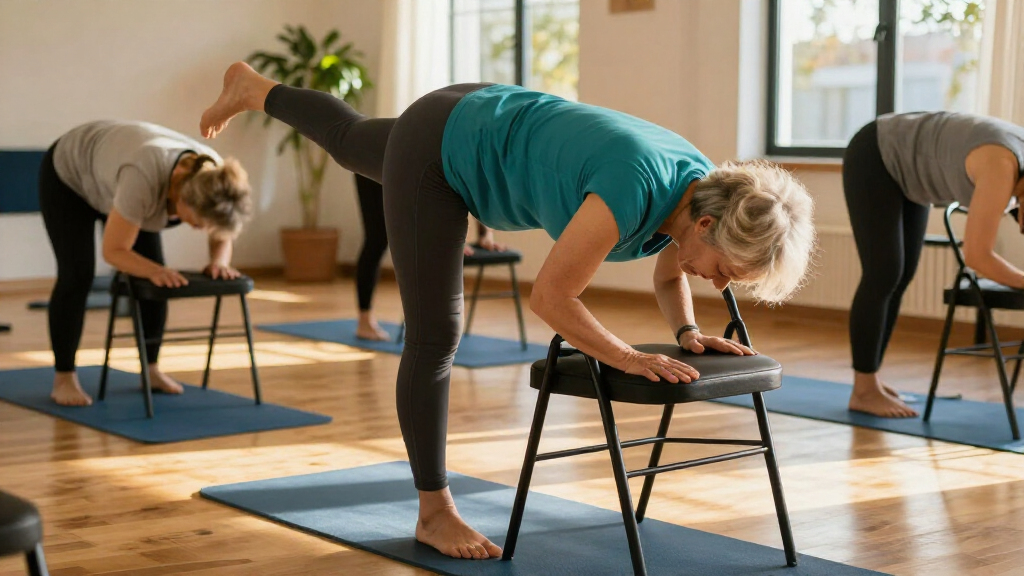
The other three moves focus on controlled leg movement and balance. For the scooter, rest the hands lightly on a surface, shift weight to one leg and slide the other foot back and forward, with toes on the floor; the report suggests three rounds of 10 to 15 repetitions per side. Marching involves lifting one knee while standing on the other leg, also for three rounds of 10 to 15 per side. For standing hip abduction, lift a straight leg out to the side, with up to 10 repetitions per side. O’Leary’s instructions allow using a chair, table or counter for support.
An Upright Option for Pilates
The routine addresses a practical barrier: some people may find floor exercises uncomfortable or difficult to access. Standing variations let them try movements without moving to and from the floor, while the suggested support options offer a way to steady themselves during balance-focused exercises.
The exercises are not presented as a tested program with measured results. The report gives no participant data, comparison with mat Pilates or evidence that completing the routine will prevent the effects of sitting. Readers should treat O’Leary’s comments as an instructor’s guidance about movement, rather than a guarantee of a particular fitness or health outcome.
Products Worth Considering

Levoit Vital 100S-P Air Purifier

Dyson V8 Cyclone Cordless Vacuum

Sonos Era 100 SL Compact Microphone-Free Speaker, White
As an affiliate, we earn on qualifying purchases.
Four Moves, Three Focus Areas
Pilates is commonly associated with mat sessions and reformer equipment, but the exercises in Fit&Well’s report use only body weight and, if needed, a nearby support surface. The sequence combines spinal rotation with hip and leg movements, including exercises that ask the person to stand on one leg.
The report supplies a suggested number of sets or repetitions for each move, but does not set out a complete weekly schedule, warm-up or progression plan. For the scooter on a wooden floor, it suggests wearing a sock or placing a towel under the moving foot. The marching and hip-abduction instructions recommend holding a stable surface when needed.
“Standing Pilates exercises might sound as though they’re easy, but they test you in many ways that floor-based moves won’t.”
— Helen O’Leary, physiotherapist and clinical director at Complete Pilates
Evidence and Individual Suitability
The Fit&Well report does not identify a study testing these four exercises or quantify their effects. It is also unclear how the routine may need to be adapted for people with specific injuries, balance limitations or other health concerns. The source offers general exercise instructions, not an individual assessment, and does not say that the sequence is suitable for everyone.
People unsure whether a movement is appropriate for them can seek guidance from a qualified health or exercise professional. The instructions do not specify how to respond to pain or other symptoms during exercise.
How to Try the Routine
The source describes the moves as exercises to try at home but does not announce a class, trial or follow-up research. Readers who choose to try them can follow the listed repetitions and use a stable surface for support, particularly during marching and side leg lifts. The report gives no timeline for when a person should expect changes or a plan for increasing difficulty.
Any further claims about benefits would need additional evidence beyond the instructor’s comments and exercise descriptions in the report. For now, the confirmed development is a set of four recommended standing moves, not a clinical finding about their effectiveness.
Key Questions
What standing Pilates exercises did Helen O’Leary recommend?
She recommended a standing book opener, scooter, marching and standing hip abduction. The set combines upper-body rotation with leg movements that challenge balance.
Do the exercises require Pilates equipment?
The instructions describe body-weight movements and do not call for a reformer or other Pilates equipment. A chair, table or countertop can be used for support where needed.
How many repetitions does the report suggest?
The suggested amounts vary: three sets of four to five book openers per side; three rounds of 10 to 15 scooter repetitions and marches per side; and up to 10 hip-abduction repetitions per side. These are the report’s instructions, not a personalized plan.
Does the report prove standing Pilates improves posture or core strength?
No. O’Leary said standing Pilates challenges the core and may encourage better posture, but the report does not cite research measuring those outcomes for this routine.
Are these exercises suitable for everyone?
The report does not establish that they are suitable for every person or health condition. Anyone uncertain about their suitability can consult a qualified health or exercise professional.
Source: fitandwell.com