TL;DR

Turn quiet afternoons into listening time
- Thousands of audiobooks, podcasts and originals
- Listen on your phone, tablet or Echo — also offline
- Cancel anytime
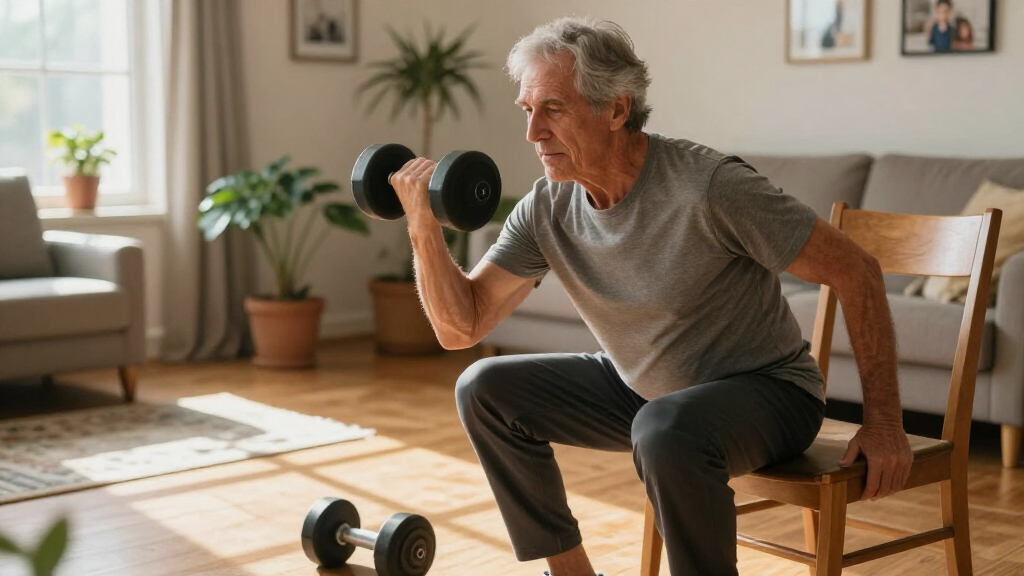
Fit&Well published a contributor’s account of introducing his 73-year-old father to a short dumbbell routine: goblet squats, single-arm rows and overhead presses. The article presents the moves as a practical way to work on strength used in daily tasks, but it does not report measured results or a clinical assessment of the routine.
Fit&Well has published a first-person report in which a contributor describes giving his 73-year-old father a three-move dumbbell routine: goblet squats, single-arm rows and overhead presses. The contributor says the plan was designed to fit his father’s limited time and work on strength used in everyday activities; the report does not provide measured evidence of the routine’s results.
The contributor says his father had remained active but had recently let strength training lapse while caring for his wife, who has Parkinson’s. In response, he bought his father light-to-medium dumbbells and reviewed lifting technique, including keeping a weight close to the chest, bracing the core and maintaining an upright position. They first spent a few weeks practicing bodyweight movements, the report says.
The three exercises selected were a dumbbell goblet squat, a single-arm dumbbell row and a dumbbell overhead press. The article suggests three sets of eight to 12 repetitions for each move. Those figures are the contributor’s proposed routine, not a regimen tested or prescribed by a medical professional in the report.
The article offers easier variations: a bodyweight or chair-supported squat, a kneeling row, and a seated overhead press with back support. Its instructions emphasize controlled movement and stable positioning. It also says the press can be done one arm at a time if pressing with both arms is too challenging. The report does not say how often the father completed the workout or give details of the weights used.
Exercises Linked to Everyday Tasks
The report’s practical focus is on movements that resemble common daily actions. A squat works a pattern used when standing from a chair or lowering to pick something up. A row trains a pulling action, while an overhead press relates to reaching and lifting objects. That framing may help readers understand why the contributor chose these exercises rather than presenting them as a general fitness challenge.
The account also describes a time constraint: the father has caregiving responsibilities and little time for himself. A short list of movements may be easier to plan than a longer program, but the story does not establish that three exercises are sufficient for every older adult or that this routine improves mobility, prevents injury or produces a particular strength outcome. Individual ability and health needs differ.
For readers considering strength work later in life, the story is best understood as one person’s experience, not individualized guidance. The report recommends starting with bodyweight or supported versions when needed, but it does not assess the father’s medical history or provide advice for people with pain, balance problems or other conditions. A qualified health or fitness professional can help adapt exercise to an individual’s needs.
Products Worth Considering

Philips Hue Festavia Globe Outdoor String Lights, 32 Bulbs, 91 ft

Philips Hue Bridge Pro Smart Lighting Hub

Philips Hue Large Smart Light Tube, Black – White and Color Ambiance LED Color-Changing Light – 1 Pack
As an affiliate, we earn on qualifying purchases.
A Gradual Return to Strength Work
The contributor says his father was not starting from a completely inactive baseline: he had always been active, but had recently neglected strength training. The account therefore describes a return to one part of his exercise routine, rather than a documented transformation from inactivity to fitness.
Before adding dumbbells, the pair practiced bodyweight versions of basic movement patterns, including squatting, hinging at the hips, lunging and pushing. The report presents this as preparation for working with weights and a chance to refresh technique. It does not give a detailed schedule for those practice sessions or say whether a trainer or clinician assessed the father.
The exercise descriptions include form cues and modifications. For the squat, the article advises keeping the knees aligned over the toes and the chest upright. For the row, it describes hinging forward with a flat back and lowering the weight under control. For the press, it advises bracing the core and bringing the weights back to shoulder level. These are instructions from the source report, not a finding from a controlled study.
Results and Safety Details Missing
The report does not say how long the father followed the routine, how frequently he trained, what weights he used or whether he experienced measurable changes in strength or mobility. It also does not include independent testing, a clinical evaluation or a comparison with another program. The claimed purpose of the routine should not be confused with documented results.
Other details that could affect how readers interpret the account are not provided, including the father’s medical history, any exercise-related limitations and whether a professional reviewed the plan. The article gives easier exercise options but does not establish that the routine is appropriate for every person aged 73 or for people with particular health conditions.
No Follow-Up Results Reported
The source report describes the exercises and suggested modifications but does not announce a follow-up, a longer training plan or a later assessment of the father’s progress. No next milestone is specified, so it remains unknown whether Fit&Well or the contributor will report outcomes from continued use of the routine.
For now, the development is a practical first-person account rather than a formal exercise study. Readers interested in trying similar movements can review the source’s instructions, but should seek guidance from a qualified professional when personal health, balance, pain or exercise limitations affect what is appropriate.
Key Questions
What are the three exercises in the routine?
The routine features a dumbbell goblet squat, a single-arm dumbbell row and a dumbbell overhead press.
How many sets and repetitions does the report suggest?
The Fit&Well article suggests three sets of eight to 12 repetitions for each exercise. It presents this as the contributor’s proposed routine, not a medical prescription.
What easier versions does the article describe?
It suggests trying a bodyweight squat or using a chair for support, doing the row while kneeling on one knee, and performing the overhead press seated with back support or one arm at a time.
Does the report show that the routine improved the father’s strength?
No measured results are provided. The article explains the routine’s aims, but does not report changes in strength, mobility or other outcomes.
Source: rss