
TL;DR

Turn quiet afternoons into listening time
- Thousands of audiobooks, podcasts and originals
- Listen on your phone, tablet or Echo — also offline
- Cancel anytime
Tai Chi teacher Brian Thompson shared a five-minute routine involving self-massage, breathing and three slow movement sequences. Thompson says the practice can help ease tension and support a calmer, more focused start to the day; the report does not provide clinical evidence or measured results for this specific routine.
Tai Chi teacher Brian Thompson has shared a five-minute morning routine combining self-massage, gentle arm movements and slow weight shifts, which he says can help release tension and settle the mind. The routine, reported by Fit&Well, offers readers a short sequence they can try at home, though the report does not present research measuring its effects.
The practice begins with self-massage and Qigong body cupping. Sitting on a chair or the edge of a bed, participants massage their neck, arms, midsection and legs, then cup their hands and gently pat those areas. Thompson’s instructions call for relaxed shoulders and wrists, with a hollow tapping sensation rather than a forceful impact.
Next is “Lifting water,” repeated three to five times. Standing with feet about shoulder-width apart and knees slightly bent, a participant raises relaxed arms to shoulder height while inhaling, then lowers them with soft elbows while breathing out through the nose. The routine’s posture guidance emphasizes keeping the knees and feet aligned and avoiding tension in the arms.
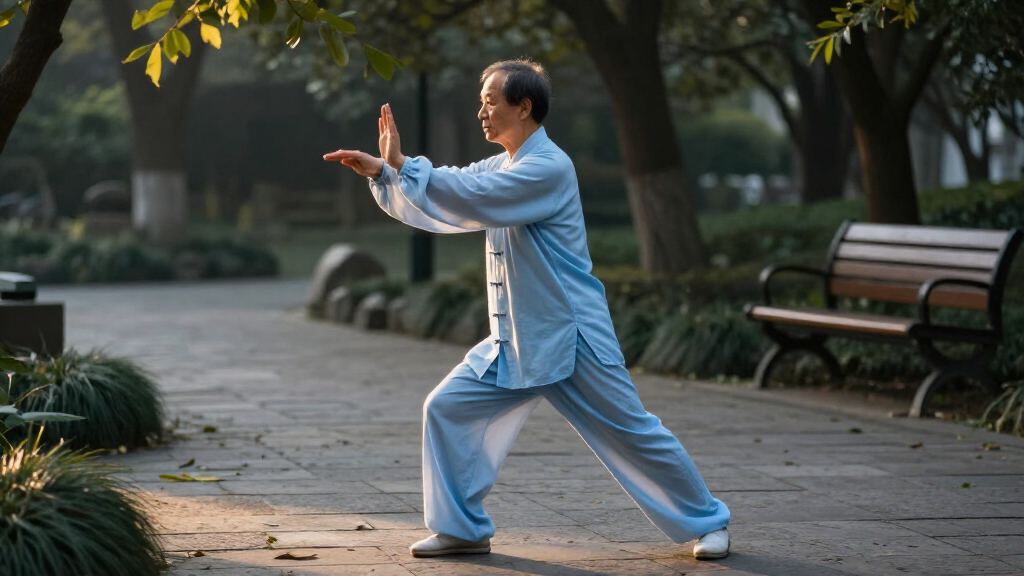
The third movement, silk reeling, or chan si gong, pairs a gentle turn of the waist with a shift of body weight from one leg to the other. One hand traces a slow path across the body, rising toward shoulder height and returning to waist level. Thompson advises practicing one side slowly before switching sides, keeping the joints soft and the movement continuous.
The sequence ends with “Gather and release,” repeated three to five times. With feet slightly wider than shoulder-width, participants raise their arms out to the sides and overhead, then turn their palms down and lower their hands to waist level. The wrists gently flex and extend during the descent. The instructions pair the rising and lowering movements with nasal breathing.
A Short Routine for Morning Stiffness
The routine is presented as an accessible way to begin the day with slow, deliberate movement. Its instructions can be followed in a small space and start seated before moving to standing exercises. That may appeal to people looking for a brief practice that does not require equipment, although the source does not report how participants respond or compare it with other morning activities.
Thompson links the morning timing to waking up stiff joints and developing a steadier mindset before daily tasks. Those are the teacher’s stated aims, rather than measured outcomes established in the report. Readers should distinguish the proposed benefits from evidence: Fit&Well provides the routine and Thompson’s comments, but no trial results, participant data or independent assessment of this exact sequence.
The practical value for readers lies in the clear movements and pacing cues. The instructions repeatedly call for soft joints, relaxed posture and unhurried motion, which give participants a way to approach the practice without treating it as a fast workout. The article frames it as an option for a calmer start, not as a substitute for treatment or a guaranteed way to improve focus.
Products Worth Considering

Ring Outdoor Cam 4K Plus Battery Security Camera, 3-Pack, White

Philips Hue Large Smart Light Tube, Black – White and Color Ambiance LED Color-Changing Light – 1 Pack

Dreame L50 Ultra Robot Vacuum and Mop
As an affiliate, we earn on qualifying purchases.
How Thompson Describes Tai Chi
Fit&Well describes Tai Chi as a mindful movement practice built around slow, intentional exercises. In the report, Thompson says it can help release joint stiffness, muscle tightness and mental stress. These statements are attributed to the instructor; the supplied source material does not cite studies or provide a clinical evaluation of those effects.
Thompson, identified as the founder of bnew4life, says Tai Chi can be practiced at any time of day, while a morning session may help people feel more awake and focused. He describes the sequence as a way to establish calm breathing and avoid feeling rushed. The report supplies no broader history of the practice or details about Thompson’s training beyond his identification as a Tai Chi teacher.
The five-minute sequence moves from seated touch-based movements to standing exercises. Its progression gives readers a brief introduction to coordinated movement and breathing: first massage and light tapping, then raising and lowering the arms, turning and shifting weight, and finally sweeping the arms overhead. The report recommends moving slowly and does not set out a required pace for the full routine beyond the repetitions specified for two movements.
““It works to gently release deep-seated joint stiffness, muscle tightness, and mental stress.””
— Brian Thompson, Tai Chi teacher and founder of bnew4life
Evidence and Individual Responses
The report does not say whether the routine has been studied as a five-minute sequence, how many people have tried it, or whether it produced measurable changes in tension, stiffness, energy or focus. The benefits are presented as Thompson’s guidance, and the source material supplies no comparison group, baseline or time window for assessing results.
It is also unclear how the movements should be adjusted for people with limited mobility, balance concerns or pain. The instructions describe general posture and pacing but do not include individualized modifications or screening advice. The article does not say whether all four parts must be completed together or how often the routine should be practiced to notice any effect.
Readers Can Try the Sequence
The next step described in the report is for readers to follow the four movements at their own pace, starting with the seated massage and progressing through the standing exercises. Thompson advises not rushing, keeping the limbs relaxed and coordinating the movements with nasal breathing.
Fit&Well’s source material does not announce a follow-up study, additional guidance from Thompson or a planned update to the routine. Any claims about its effects would need further evidence, such as measured outcomes over a defined period. For now, the development is the publication of an instructor’s short morning sequence, with its results for individual readers left unreported.
Key Questions
What does the five-minute morning Tai Chi routine include?
It includes self-massage and gentle hand cupping, “Lifting water,” silk reeling, and “Gather and release.” The latter two standing sequences involve slow turns, weight shifts or raising and lowering the arms.
Who shared the routine?
Brian Thompson, identified by Fit&Well as a Tai Chi teacher and founder of bnew4life, shared the practice and its instructions.
Does the report prove the routine improves focus?
No. Thompson says a morning practice can support a calm, focused mindset, but the report provides no study results or measured focus outcomes for this specific routine.
How many repetitions are recommended?
Thompson’s instructions recommend three to five repetitions each for “Lifting water” and “Gather and release.” Silk reeling is described as a slow movement practiced on one side before switching sides.
Source: rss