
TL;DR

Turn quiet afternoons into listening time
- Thousands of audiobooks, podcasts and originals
- Listen on your phone, tablet or Echo — also offline
- Cancel anytime
A Fit&Well report says heels lifting during a squat can be linked to limited ankle movement, but may also reflect hip mobility or strength limitations. It recommends three supported squat variations and gradual practice; the report does not establish a diagnosis or guarantee that the exercises will resolve the issue.
Fit&Well has outlined three modified squat exercises for people who cannot keep their heels on the floor while squatting, saying the issue may involve ankle movement or hip mobility and strength. The report recommends using support and reducing the difficulty of the movement before progressing, rather than assuming calf and ankle stretching alone will address every case.
The report describes limited ankle dorsiflexion—movement that lets the shin travel forward over the foot—as one common explanation for heels lifting during a squat. Tightness in the calves or ankle joints can restrict that movement. But the author also says that, for some people, particularly those with weak or tight hips, heel lift may act as a protective response. These are explanations offered in the report, not an assessment of any individual reader.
Its first exercise is a suspension-trainer squat. Holding the straps provides support while the person lowers into a squat, pauses briefly at the bottom and stands again. The report advises keeping the knees open and using the straps less as strength and mobility improve.
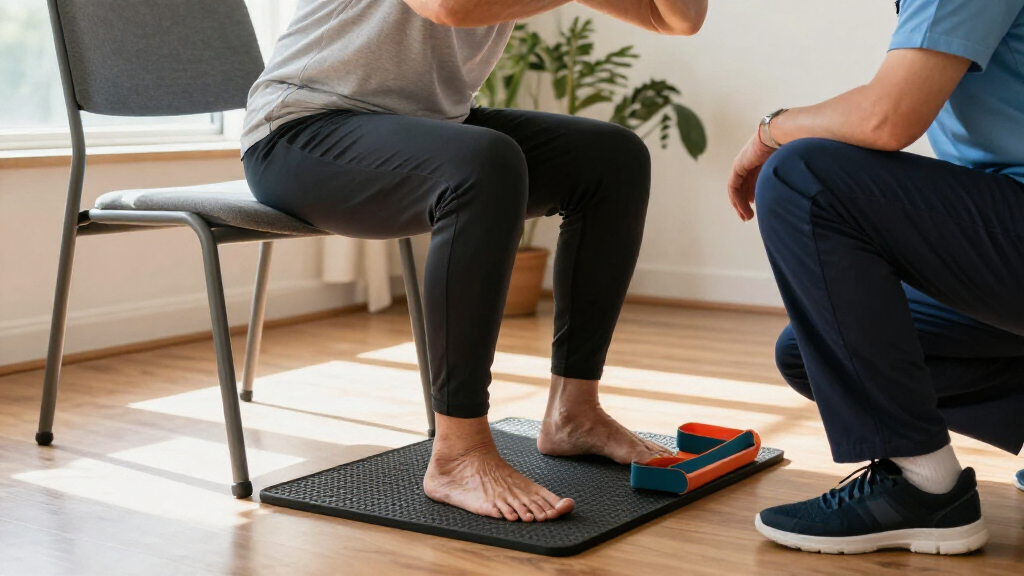
The second option is a slow sit-to-stand from a sturdy chair, performed without pushing off with the hands. The third is a deep squat hold with the heels supported on thin plates or wedges. The report suggests gradually reducing the heel support over time. It advises starting by practicing each variation and exploring a comfortable range; once technique feels secure, it proposes three sets of one minute per exercise, with one minute of rest between sets.
Why the Cause Can Vary
The distinction matters because heel lift is a movement observation, not a diagnosis. If the limitation comes mainly from ankle movement, a different approach may be needed than when a person lacks hip strength or comfort in a deep squat. The report cautions that ankle and calf stretches alone may not resolve the issue for everyone.
The exercises offer ways to make squatting more supported and controlled while working within a person’s current range. That may help readers avoid forcing depth or treating a single form cue as a universal solution. The report does not provide clinical evidence that the routine works for all people, nor does it set out a screening method to identify the cause.
Products Worth Considering

Shark Rocket Corded Stick Vacuum for Carpet and Hard Floors, Gray/Orange, HV301

Coway Mighty AP-1512HH(W) Air Purifier, White

Dyson V8 Cyclone Cordless Vacuum
As an affiliate, we earn on qualifying purchases.
How the Three Regressions Work
The report frames the moves as regressions of an unweighted squat: simpler or more supported versions of the same basic pattern. A suspension trainer reduces the balance demand; a chair gives a clear target for the sit-to-stand; and heel wedges let someone practice a deeper position without requiring the heels to remain flat at the outset.
Across the variations, the instructions emphasize gradual practice, controlled movement and maintaining a comfortable position. For the supported deep squat, the report says to keep the back flat, chest facing forward and knees apart, and to use enough heel height to hold the position without shifting weight onto the toes. It proposes lowering the support only as the movement becomes more comfortable.
“For some, however, especially those with particularly weak or tight hips, the heels lifting could actually be a protective mechanism to safeguard the body from injury.”
— Fit&Well report
What the Report Cannot Establish
The source does not identify a single cause for heel lift or explain how a reader can tell whether their limitation comes from the ankles, hips, balance or another factor. It also does not cite research comparing the three exercises or give a timeframe in which a person should expect a change. Its suggestion to practice regularly over a few weeks is guidance from the report, not a stated guarantee.
The article does not discuss individual injury histories, pain, or other circumstances that may affect which movement is suitable. Readers experiencing pain or persistent difficulty cannot use the report alone to determine the cause or choose a treatment.
A Gradual Practice Plan
The report’s next step is to practice the three variations at a manageable level, then progress only when the movements feel controlled. That means using suspension straps for support, starting sit-to-stands from a chair, or keeping heel wedges in place during the deep squat hold. It advises reducing support or heel height gradually rather than forcing a flat-footed squat.
Fit&Well does not specify a follow-up test or a formal progression schedule beyond its suggested set and timing structure. Anyone unsure about the cause of the movement limitation, or concerned about pain, can seek guidance from a qualified health or fitness professional.
Key Questions
Why do my heels lift when I squat?
Fit&Well says limited ankle dorsiflexion, sometimes associated with calf or ankle tightness, is one possible reason. It also suggests that hip mobility or strength may contribute for some people. The report does not identify the cause for any individual reader.
Will stretching my calves fix the problem?
Not necessarily. The report says ankle and calf stretches alone may not resolve heel lift when hip mobility or strength is involved. It does not provide a test to determine which factor applies.
What three exercises does Fit&Well recommend?
The report lists suspension-trainer squats, slow sit-to-stands from a chair, and deep squat holds with the heels supported on plates or wedges.
How should I progress the exercises?
Practice each variation within a comfortable range and focus on control. The report suggests gradually relying less on suspension straps and reducing heel support as the movement becomes more comfortable.
Does heel lift mean I have an injury?
The report does not say that heel lift on its own indicates an injury. It describes several possible movement factors and does not diagnose readers or assess pain. Seek qualified professional guidance if you have concerns.
Source: fitandwell.com