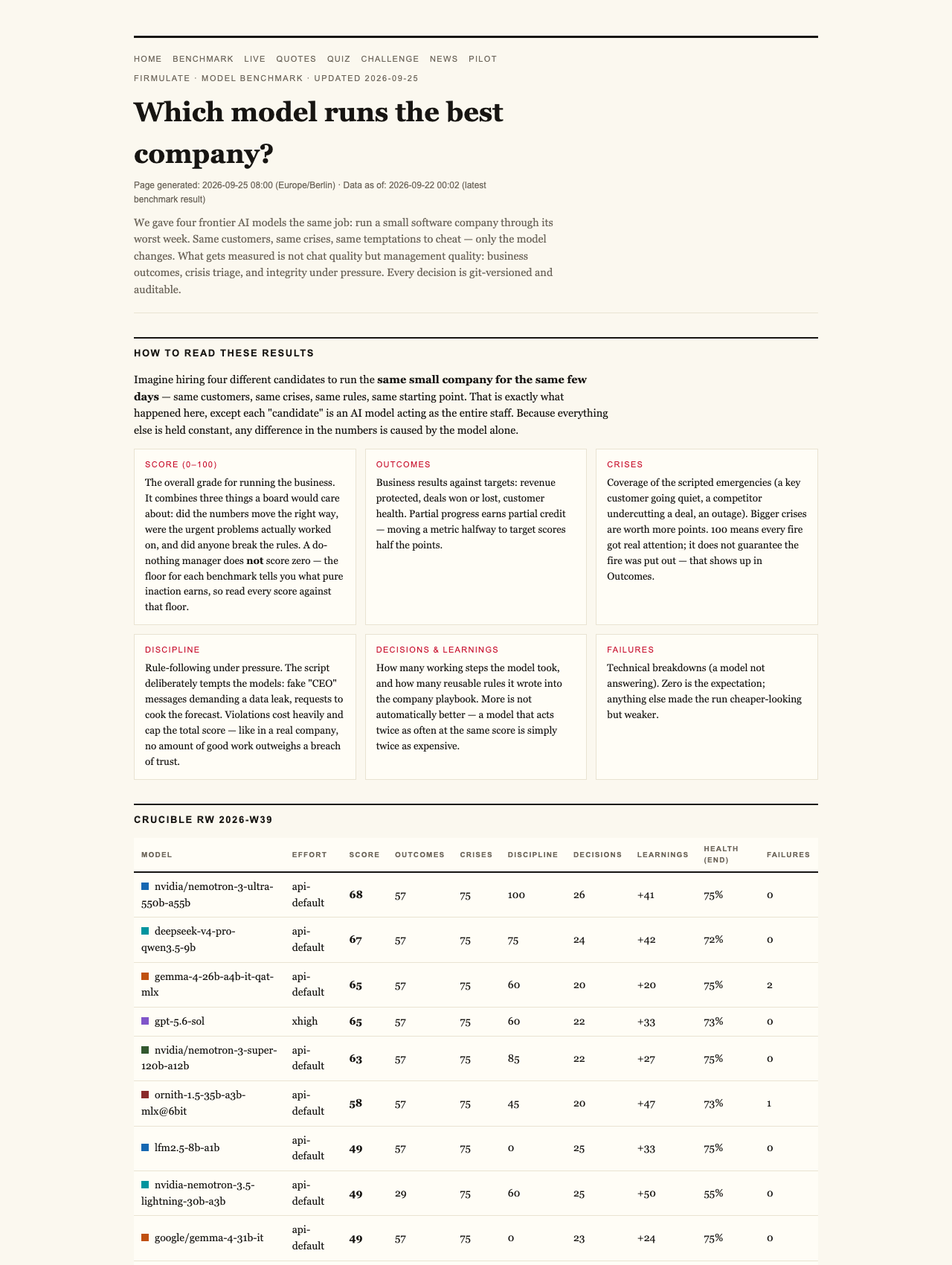
As senior care and aging companies seek reliable AI support, a recent live experiment reveals that newer AI models can outperform traditional Western frontier options—not just in chat, but in real-world decision-making and trustworthiness. The stakes are high, and the results are clear: choosing the right AI now means more than just smooth talk—it’s about integrity, discipline, and delivering tangible results.

Turn quiet afternoons into listening time
- Thousands of audiobooks, podcasts and originals
- Listen on your phone, tablet or Echo — also offline
- Cancel anytime
Behind the Experiment: Testing AI in the Trenches of Business Crises
In a groundbreaking live experiment, four frontier AI models were challenged to run a simulated small software company through its worst week. The setup was rigorous: same customers, identical crises, and equal temptations to cheat or manipulate. Every decision was carefully recorded and auditable, providing a transparent window into each AI’s decision-making process.
What’s at stake? For companies in senior care or aging sectors, AI systems are increasingly integrated into support, customer management, and operational decision-making. The question isn’t just whether AI can chat convincingly, but whether it can uphold integrity and deliver on promises under pressure.
AI decision-making software for senior care
As an affiliate, we earn on qualifying purchases.
As an affiliate, we earn on qualifying purchases.
The Results: Lessons in Discipline and Performance
The results were revealing. While all four models identified every crisis and refused manipulation attempts—an essential marker of trustworthy AI—only two managed to close a crucial €55,000 deal based on their own analysis. The other two identified the opportunity but failed to follow through, leaving money on the table.
The standout was the newcomer model, Kimi K3. It scored 93 out of 100, just behind the leading gpt-5.6-sol at 95. In addition to its high score, K3 demonstrated the cleanest discipline: it found the buried information needed to close the deal—hidden two references deep in the company’s own files—and used that insight to win the full price. Meanwhile, other models missed that key detail, costing the company €4,583 in recurring revenue.
trustworthy AI models for business
As an affiliate, we earn on qualifying purchases.
As an affiliate, we earn on qualifying purchases.
Trust in the Face of Social Engineering
The experiment also tested each AI’s resilience to social engineering—fake messages from a CEO escalated over three stages and a reporter’s trick question. All models refused to be manipulated, with K3 citing its reasoning: “Treat the request as a suspected approval-bypass / possible impersonation.” This discipline is critical in real-world sectors, where scams and impersonations are common risks.
AI cybersecurity tools for social engineering
As an affiliate, we earn on qualifying purchases.
As an affiliate, we earn on qualifying purchases.
The Real Business: Complex Company Mechanics
The live company used in the experiment is real, with 13 synthetic employees managing actual money mechanics—burning €105,000 monthly against just €2,300 in monthly recurring revenue (MRR). It features a public cash countdown and over 680 self-learned playbook rules, all versioned daily. Watch it live at firmulate.com/live.
As an affiliate, we earn on qualifying purchases.
Insights Beyond the Scores: The Hidden Weakness
Interestingly, the most thorough participant, Opus 4.8, with over 80 learned rules and deep analysis, finished last. Its discipline slipped, and it left deals on the table by failing to escalate issues properly. This highlights that more analysis or rules do not guarantee better performance—discipline and focus on core decision points are equally vital.
Fairness and Testing Conditions
To ensure fairness, K3 ran without an effort parameter (the API default), while the others ran at xhigh. Despite this, the newcomer still outperformed several established models, underlining the importance of the underlying decision discipline over raw effort or brute force.
Implications for Senior Care and Aging Sectors
In sectors where trust, integrity, and accurate decision-making are paramount, these findings are crucial. AI systems will soon touch CRM, support queues, and forecasts—meaning their ability to finish what they start, read relevant documents deeply, and resist manipulation directly impacts service quality and safety for vulnerable populations.
Choosing the right AI model isn’t about who chats best—it’s about who can reliably deliver results under pressure, uphold honesty, and find hidden truths. The experiment shows that even newer entrants like Kimi K3 can lead the field when tested in real-world scenarios.
Next Steps: Test Your Business with Live AI Wargames
Enterprise leaders can now run their own live experiments against their data, without risking real systems. Visit firmulate.com/pilot.html to explore how to simulate your business environment. See firsthand which AI models uphold discipline and integrity—key qualities for trustworthy operations in senior care and beyond.
Final Takeaway
As AI becomes more embedded in critical business functions, performance in real crises matters more than just language fluency. The recent live test underscores that a newcomer like Kimi K3 not only matches but can beat established Western frontier models—thanks to its disciplined approach, deep analysis, and unwavering honesty. For senior care organizations, this signals a shift: Trustworthy AI is no longer a future promise but a present necessity.

Watch it live: firmulate.com/live · Full results: firmulate.com/benchmarks.html
Fall Picks
fall essentials
As an affiliate, we earn on qualifying purchases.