TL;DR

Turn quiet afternoons into listening time
- Thousands of audiobooks, podcasts and originals
- Listen on your phone, tablet or Echo — also offline
- Cancel anytime
Researchers are examining firearm access among older adults with worsening memory or confusion, including people who have not been diagnosed with dementia. They say early conversations and practical steps such as locking guns and storing them unloaded can reduce risks while preserving an older person’s role in decisions.
Researchers and public health experts are urging families and health professionals to discuss firearm storage with older adults who show memory or thinking problems, even before they receive a dementia diagnosis. The concern is that confusion, depression and ready access to a gun can increase the risk of suicide or an accidental shooting, while early, respectful conversations may help people make safer choices themselves.
The issue is illustrated by a case described to KFF Health News by Laura Prater, a firearms researcher at Ohio State University. While interviewing a 72-year-old retired health administrator near Seattle for a firearm-safety study, Prater learned that a questionnaire indicated mild cognitive impairment. The man’s doctor had also diagnosed depression. He lived alone and owned a shotgun and a recently acquired .45-caliber pistol.
Prater said the pistol was loaded in a nightstand drawer, while the unloaded shotgun was propped beside the bed with its ammunition nearby. The man viewed the guns as protection. Prater called the arrangement alarming, but said it was not uncommon. The account describes one research interview; it does not establish that the man harmed himself or anyone else.
A survey across seven states found that one-third of adults 65 and older who reported subjective cognitive decline said a gun was present in their household. One-quarter of that group had not stored firearms securely. Researchers said the difference in unsecured storage compared with older adults reporting normal cognition was not statistically significant. They warn that worsening confusion could be associated with suicide risk, accidental discharge or mistaken shootings involving relatives, visitors or care workers.
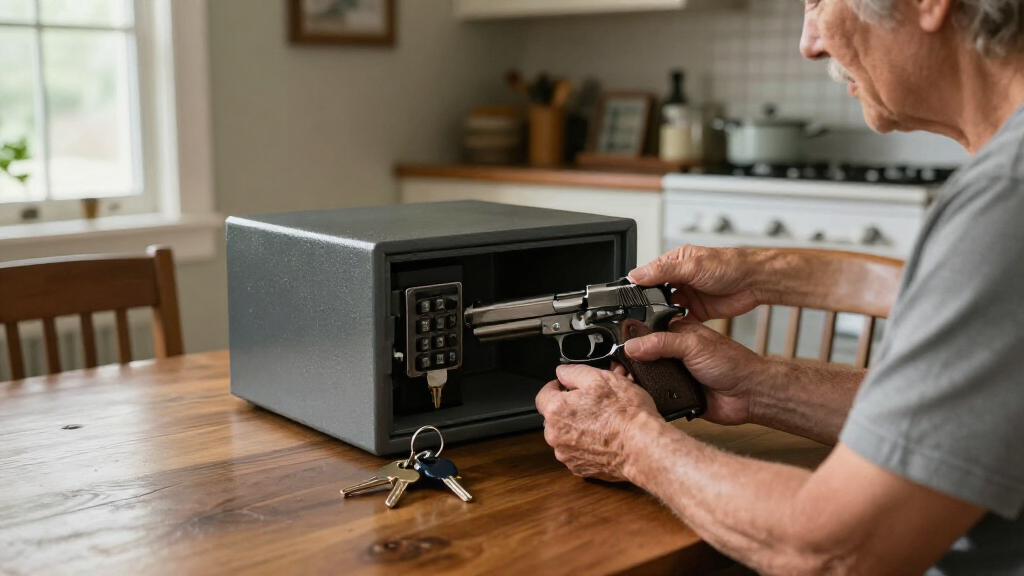
Researchers favor a harm-reduction approach over insisting that an older person give up firearms. Suggested measures include discussing risks without judgment, keeping guns unloaded and locked, and offering trigger locks or lockboxes. The report says some programs provide these devices free. The aim is to reduce access in a crisis while allowing people to take part in decisions about their belongings and safety.
Safer Storage Before a Diagnosis
The concern reaches beyond people with a formal dementia diagnosis. Older adults may experience memory loss or confusion before diagnosis, a period when they can still take part in decisions about access and storage. Researchers say that makes early conversations a practical opportunity to reduce immediate hazards without treating a diagnosis, by itself, as a reason to remove someone’s firearms.
The stakes are substantial. U.S. Centers for Disease Control and Prevention data cited in the report show that 8,226 Americans aged 65 and older died from firearms in 2024, an average of nearly 23 a day. More than 90% of firearm deaths in this age group were suicides, according to the report. The figures describe deaths, not the number of people with dementia or the share of incidents caused by cognitive impairment.
For families, clinicians and older gun owners, the approach may also affect whether a safety discussion happens at all. Researchers say some owners fear that telling a doctor about firearm access, depression or memory problems will automatically lead to confiscation. The report says those conditions alone do not require medical personnel to take that step. A conversation focused on safer storage can address risk without assuming that relinquishing a firearm is the only option.
Products Worth Considering

Philips Hue Play Gradient 65-Inch Smart TV Light Strip

Hisense E6SR Series 55-Inch 4K UHD Hi-QLED Roku Smart TV

Dyson V8 Cyclone Cordless Vacuum
As an affiliate, we earn on qualifying purchases.
Why These Conversations Are Difficult
Gun ownership can be closely linked to identity, independence and protection. Kelsey Conrick, a researcher at the University of Washington’s Center for Firearm Injury Prevention, said asking someone to give up a firearm can feel like taking away their identity as a protector. Emergency physician Marian Betz of the University of Colorado Anschutz said older adults may feel more vulnerable and fear being victimized. Those concerns can be real to the person, even when researchers question whether a gun makes the home safer overall.
Medical conversations are uncommon, according to research cited in the report. In a 2020 study led by Betz, about 5% of caregivers for people with dementia said a health professional had ever discussed firearm safety with them. The report also describes interviews with 50 dementia caregivers: many had seen unsafe behavior or near misses, but worried that pressing an older relative to surrender or secure firearms could create conflict and damage a relationship they would rely on during later care.
Legal options vary. The report says 22 states and Washington, D.C., have extreme risk protection order laws that can temporarily restrict firearm access. It also notes that depression or dementia, on their own, do not require clinicians to report a patient or take firearms away. The cited research therefore points to family and clinical discussions, rather than assuming a uniform legal response.
““It was alarming,” she said, “but not uncommon.””
— Laura Prater, firearms researcher at Ohio State University
Limits of the Available Evidence
The survey findings do not show that cognitive decline caused unsecured storage or that a particular firearm arrangement led to an injury. The reported difference in nonsecure storage between people with subjective cognitive decline and those with normal cognition was not statistically significant. The survey also does not establish how many respondents later developed dementia or experienced a firearm-related incident.
The report does not give a single estimate of how often people with dementia have access to guns; it says researchers estimate that at least one-third do. The individual case is an example from a study interview, not a measure of prevalence. It remains unclear which conversations or storage interventions work best across different families and circumstances, and how often older adults accept them.
Researchers also describe barriers to disclosure and discussion, but the report does not quantify how frequently older patients withhold firearm ownership from clinicians. Laws differ by location, and whether an extreme risk protection order applies depends on jurisdiction and circumstances. The source material does not identify a new national policy or a newly released study behind the report.
Earlier Conversations and Storage Steps
The next step described by researchers is to raise firearm access and storage before cognitive problems become more severe, while the older adult can participate in choices. Clinicians and family members can ask whether guns are present, discuss the person’s reasons for keeping them, and consider whether unloaded, locked storage or safety devices would lower risk. The report does not set out a single protocol or timeline for these discussions.
For relatives who fear damaging a relationship, the harm-reduction approach offers a focus on specific storage changes rather than beginning with a demand to surrender firearms. Researchers say that acknowledging fears about safety and independence may make the discussion more constructive. Whether a particular plan is workable will depend on the person, household and local laws.
Anyone worried about immediate danger should seek help from qualified professionals or local emergency services. The source report also directs people experiencing a mental health crisis in the United States to call or text the 988 Suicide & Crisis Lifeline. That support information is not a substitute for individualized clinical or legal guidance.
Key Questions
Does early memory loss automatically mean a person must give up firearms?
No. The report says dementia or depression alone does not require medical personnel to take firearms away. Researchers describe safer storage and shared decision-making as alternatives to starting with firearm surrender.
What firearm storage steps do researchers recommend?
The report describes keeping guns unloaded and locked, with ammunition secured, and using devices such as trigger locks or lockboxes. It says some programs offer these devices free of charge.
How common is firearm access among older adults with memory concerns?
In a survey in seven states, one-third of adults 65 and older with subjective cognitive decline reported a gun in their household. That survey result does not establish how many participants had dementia or later experienced a firearm incident.
Are firearm deaths among older adults mostly suicides?
According to the report’s account of CDC data, more than 90% of firearm deaths among people aged 65 and older were suicides. It reports 8,226 firearm deaths in this age group in 2024.
Where can someone in the United States seek immediate crisis support?
The report says people experiencing a mental health crisis can call or text the 988 Suicide & Crisis Lifeline. For immediate danger, contact local emergency services.
Source: kffhealthnews.org