
TL;DR

Turn quiet afternoons into listening time
- Thousands of audiobooks, podcasts and originals
- Listen on your phone, tablet or Echo — also offline
- Cancel anytime
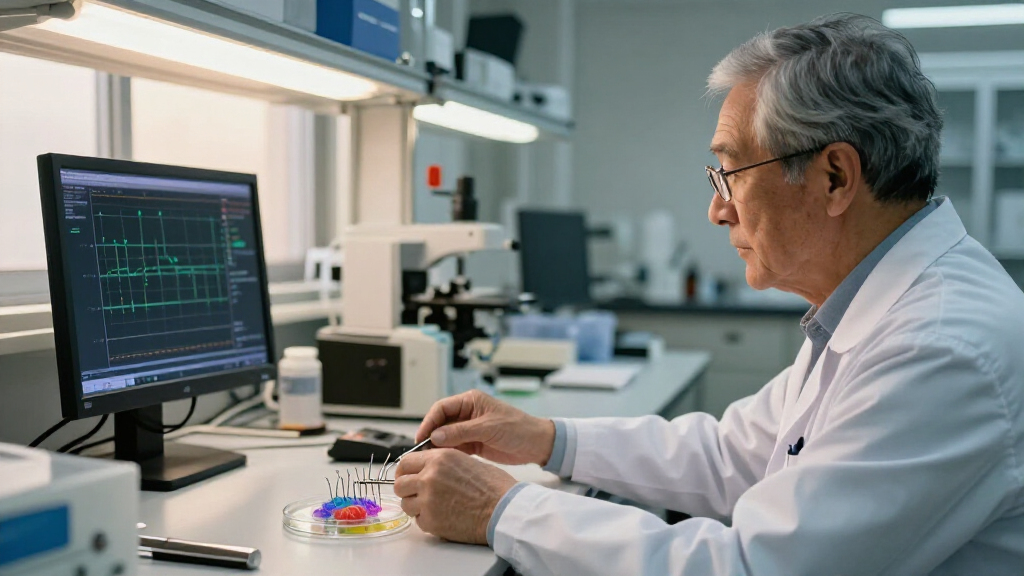
Researchers are developing systems that connect lab-grown human brain organoids to electrodes and test how the cells respond to simple tasks. The aim is to use learning-related electrical activity to help screen drugs for conditions such as Alzheimer’s and Parkinson’s, but the approach is still under development and has not been shown to predict which medicines work in patients.
Researchers are developing electrode-linked brain organoids that respond to simple games and tasks, with the goal of using their electrical activity to help screen drugs for Alzheimer’s and other neurodegenerative diseases. The work, discussed at the inaugural International Conference on Organoid Intelligence in Washington, is at an early stage: researchers have not established that organoids’ performance can predict how a treatment will affect people.
Brain organoids are small structures grown from human cells that can develop features of brain tissue. Researchers can make them from reprogrammed skin or blood cells and place them on devices that record and deliver electrical signals. In the proposed drug-screening approach, patterns of stimulation represent elements of a task, while the organoid’s electrical response provides a measurable outcome.
Lena Smirnova, an assistant professor at Johns Hopkins University and a researcher with the Center for Alternatives to Animal Testing, is leading work supported by a five-year, $15 million NIH grant. Her group plans to combine organoids, electrical sensors and artificial intelligence in a platform called the Drug Research Organoid Intelligence Development Platform. Smirnova told Being Patient that the aim is to develop “this functional readout as alternatives to animal behavior studies.”
One example researchers draw on is a 2022 experiment by another group, which trained brain cells to play a simplified version of Pong. Electrodes sent signals corresponding to the ball’s position, and the cells’ responses controlled a paddle. Researchers also gave electrical feedback about whether a hit succeeded. Smirnova’s group hopes task-based readouts could help compare organoids from healthy people with those from people with Alzheimer’s or cognitive impairment; those comparisons are still in progress.
A Human-Cell Route to Drug Screening
Many treatments that appear promising in animal studies do not translate into effective treatments for people. The Being Patient report says that more than 99% of drugs that work in animal models fail in humans in the Alzheimer’s field. That figure underscores the problem researchers are trying to address, but it does not establish that organoid testing will perform better.
If the approach can be validated, researchers could use organoids made from human cells to compare drug effects on disease-related biology and task-linked electrical activity before deciding which candidates merit further study. Patient-derived cells could also, in principle, help researchers examine differences between individuals. For now, the work is a research strategy, not a replacement for clinical trials or a proven way to select treatments for patients.
Products Worth Considering

eufy C28 Robot Vacuum Cleaner and Mop with HydroJet Roller, 15,000 Pa Suction

Roborock RockMow X130H Wire-Free 4WD Robot Lawn Mower

Bose Lifestyle Ultra Wireless Home Speaker, White Smoke
As an affiliate, we earn on qualifying purchases.
From Organoid Models to Tasks
The approach is part of a wider effort to develop research tools that can reduce or replace some animal testing. The source report says the National Institutes of Health invested $150 million earlier this year to develop, validate and standardize such tools. That funding supports a broad goal; it should not be confused with the separate $15 million grant for Smirnova’s project.
Other researchers are applying organoid models to Parkinson’s disease. Jens Schwamborn, a professor at the University of Luxembourg and co-founder of OrganoTherapeutics, described work using organoids made from patients’ reprogrammed skin cells. His team has reported disease-related features, including neuroinflammation and alpha-synuclein aggregation, in organoids from people with Parkinson’s and relevant genetic risk factors.
Schwamborn’s team is also testing whether organoids can respond to arithmetic encoded as electrical patterns. Researchers stimulate the cells with a question, such as five plus two, and look for a signal associated with the answer. The proposed measure is how quickly the organoids forget learned associations. Schwamborn told Being Patient that his earlier work with mice, rats and monkeys left him “a bit frustrated by the inability to recapitulate disease.”
““But quickly became a bit frustrated by the inability to recapitulate disease.””
— Jens Schwamborn, professor at the University of Luxembourg, speaking to Being Patient
Validation Still Lies Ahead
It is not yet clear whether an organoid’s success on a game or task reliably reflects the memory and learning problems seen in a person with dementia. Researchers are still working on comparisons between healthy and Alzheimer’s organoids, and the report does not provide evidence that task performance predicts whether a drug will help patients.
Important questions include how consistently different laboratories can grow and test organoids, how closely the models represent the complexity of human disease, and whether results can be reproduced across people and cell lines. The report also does not identify a timeline for validating the platform or describe a treatment that has been selected through this method.
Testing the Platform’s Predictive Value
Smirnova’s team plans to develop its platform with the NIH grant, combining human brain organoids with sensors and AI. A key next step will be to test whether electrical responses can be measured consistently and distinguish meaningful differences between organoids, including those associated with disease or drug exposure.
Researchers will also need to compare organoid results with established evidence from human disease and treatment studies. Until those steps show that the readouts are reliable and useful, the work remains an experimental screening approach rather than a clinical tool. No public schedule for those validation milestones was given in the source report.
Key Questions
What are brain organoids?
Brain organoids are small, lab-grown structures made from human cells that can develop some features of brain tissue. Researchers can place them on electrode devices to send and record electrical signals.
How do researchers use games with the cells?
Electrodes deliver patterns of signals that represent parts of a task, such as a ball’s position in a simplified Pong game. Researchers record the cells’ electrical responses and can provide feedback linked to the task’s outcome.
Can this method identify an effective dementia drug now?
No evidence in the report establishes that. Researchers are developing and studying the method; whether task performance can predict drug effects in people remains unknown.
Are the organoids being used to treat patients?
No. The reported work concerns laboratory models for research and possible drug screening, not a treatment for patients or a clinical decision-making tool.
Source: beingpatient.com