TL;DR
Listen free for 30 days with Audible
Thousands of audiobooks and originals — cancel anytime.
Start your free trialAs an affiliate, we earn on qualifying purchases.
Choosing an easy-grip utensil set involves matching handle design, weight, and features to your specific needs—whether it’s tremor, weak grip, or limited wrist motion. The right tools can make eating safer, easier, and more comfortable, supporting independence at mealtime.
When it comes to eating independently, your utensils should work with you, not against you. The right set can transform a frustrating experience into one filled with confidence and dignity. But with so many options—weighted, built-up, angled—how do you pick the best?
This guide breaks down the key features to look for and offers practical advice to help you find utensils that suit your unique needs. Whether you’re managing arthritis, tremors, or limited wrist mobility, there’s a set designed to help you enjoy meal times again.
Match handle diameter and material to your grip strength and hygiene needs.
Weighted utensils help tremor but may tire weak hands; test before buying.
Angled, bendable, or rocker designs reduce wrist strain and facilitate one-handed use.
DIY foam handles are budget-friendly but less durable than commercial options.
Consult an occupational therapist for personalized recommendations tailored to your condition.
Adaptive Dining · Buyer’s Guide
Choosing an Easy-Grip Utensil Set
Eating independently starts with tools that work with you, not against you. Whether you’re managing arthritis, tremor, weak grip, or limited wrist motion, the right combination of handle design, weight, and material turns a frustrating meal into one of confidence and dignity.
“Built-up handles reduce required grip force by up to 50%, significantly easing joint stress for arthritis sufferers.”
Key Insight · Ergonomic Research01 · Fit to Condition
Match the Feature to Your Challenge
The same set that helps one person can hinder another. Start with your specific limitation, then select the design features built to solve it.
Build Up the Handle
A wider grip means less finger flexion and lower joint stress — think of turning a thin pencil into a fat crayon.
- Built-up handles around 1–1.5 inches
- Soft silicone or cushioned materials
- Lightweight construction to limit fatigue
Add Stabilizing Mass
Weight acts like a camera tripod’s counterweight, damping involuntary movement for steadier bites.
- Weighted utensils around 7–8 ounces
- Electronic stabilizing (gyroscopic) spoons
- Deeper spoon bowls to reduce spills
Let the Head Do the Turning
Angled designs keep the utensil pointed where you need it — no painful twisting required.
- Angled or bendable utensil heads
- Rocker knives for one-motion cutting
- Contoured grips with thumb indentations
Strap the Utensil to You
When closing the hand isn’t possible, attachments take over the holding entirely.
- Universal cuffs and utensil straps
- Specialized molded handles
- Professional fitting for safety and comfort
02 · The Critical Trade-Off
Weighted vs. Lightweight: Stability or Stamina?
This is the most consequential choice in the category. Weight suppresses tremor but accelerates fatigue — test both before you buy.
Weighted · ~7–8 oz
Best for: TremorAdded mass slows involuntary movement, improving precision. Parkinson’s and essential tremor users often gain immediate control — but weak hands tire faster.
Lightweight · ~2–3 oz
Best for: Weakness / FatiguePlastic or light stainless builds minimize effort — ideal post-stroke or with MS. The catch: severe tremor becomes harder to stabilize, risking spills.
Utensil Weight Spectrum (ounces)
Rule of thumb: mild tremor → weighted; significant weakness → lightweight. When in doubt, trial both — the right utensil supports independence rather than taxing it.
03 · Materials Matter
Handle Materials Compared: Foam, Silicone, Rubber
Material choice drives hygiene, durability, and grip security — especially when hands are wet or daily dishwashing is a must.
| Material | Grip Security | Durability | Hygiene / Cleaning | Cost | Best For |
|---|---|---|---|---|---|
| FoamDIY-friendly | ✓ Good, soft hold | ✗ Wears out quickly | ✗ Hand wash only; can harbor bacteria | ✓ Lowest cost | Budget builds, custom sizing with foam tubing |
| SiliconeBest balance | ✓ Non-slip; needs texture when wet | ✓ Highly durable | ✓ Dishwasher safe, antimicrobial | ~ Higher upfront cost | Daily long-term use, hygiene-first households |
| RubberTextured styles | ✓ Excellent traction | ~ May degrade over time | ~ Porous; harder to clean fully | ✓ Affordable | Maximum grip on a moderate budget |
DIY note: Wrapping foam tubing (even pipe insulation) around regular flatware is a legitimate budget hack and a common OT-clinic approach — but expect faster wear and stricter hand-washing than commercial sets.
04 · Decision Path
From Limitation to the Right Set, in Five Steps
Work through the chain in order — each answer narrows the next choice.
Identify the Limitation
Tremor, weak grip, arthritis, limited wrist motion, or no grip at all.
Match the Handle
Built-up diameter, contoured shape, angled head, or cuff attachment.
Choose the Weight
Heavy for tremor control, light for weakness and fatigue.
Pick the Material
Silicone for hygiene, foam for budget, rubber for maximum grip.
Consult an OT
An occupational therapist tailors tools to your exact condition.
Independence is the metric. The best set is the one you can use safely, comfortably, and consistently — at home and at restaurants. Many users also prefer modern, matte-finish designs that look like regular flatware, not clinical equipment.
05 · Key Takeaways
If You Remember Five Things
Match handle diameter and material to your grip strength and hygiene routine.
Weighted utensils calm tremor but can tire weak hands — test before buying.
Angled, bendable, and rocker designs spare painful wrist movement.
DIY foam handles are budget-friendly but less durable than commercial sets.
An occupational therapist can personalize recommendations to your condition.
How Handle Design Makes or Breaks Your Ease of Use
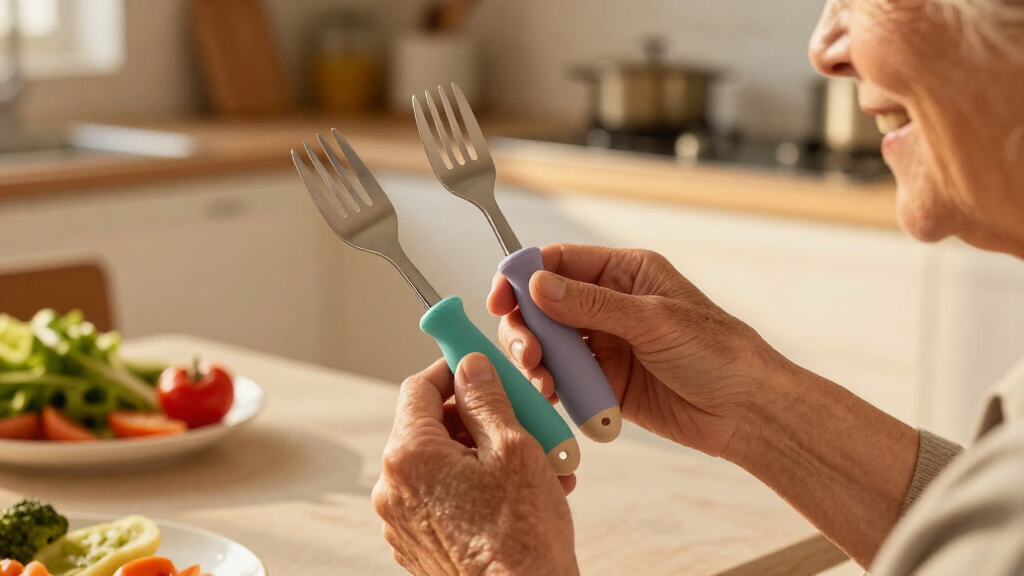
The handle is the heart of an easy-grip utensil. Built-up handles, with diameters around 1 to 1.5 inches, require less finger flexion—crucial for arthritis or weak grip users. Think of it as turning a thin pencil into a fat crayon.
Materials matter too. Silicone and rubbery coatings provide non-slip grips, even when hands are wet. For example, a silicone-coated fork stays firm in sweaty palms, reducing slips and accidents. Ergonomic shapes with contours and thumb indentations enable a natural, comfortable hold.
Some utensils feature angled or bendable heads—perfect for limited wrist rotation. Imagine a spoon that points straight ahead, making it easier to scoop from a bowl without twisting your wrist painfully.
Choosing handle design isn’t just about comfort; it directly impacts safety and control. A handle that fits well reduces the risk of slips, which can lead to spills or injuries. While larger handles are generally easier to grasp, they also require less fine motor control, making them more accessible for users with severe hand weakness or arthritis. However, overly bulky handles may be difficult for some to maneuver or store, so finding the right balance is key.
easy grip utensil set for arthritis
As an affiliate, we earn on qualifying purchases.
As an affiliate, we earn on qualifying purchases.
Choosing Between Weighted and Lightweight Utensils
Weighted utensils, often around 7 to 8 ounces, are designed to help suppress tremors, especially in conditions like Parkinson’s disease. By adding mass, they slow down involuntary movements, making it easier to eat with precision. Think of it as adding a stabilizing counterweight—similar to how a camera tripod steadies a shot. However, this added weight can be a double-edged sword. For users with limited strength or fatigue, heavier utensils may cause quicker exhaustion, leading to less independence over time. They might also be less comfortable for prolonged use, potentially discouraging regular meals.
On the other hand, lightweight utensils, often made of plastic or light stainless steel, reduce the physical effort needed to manipulate them. They are particularly beneficial for users recovering from stroke or with muscle weakness, as they lessen strain and fatigue. Yet, lighter tools may be more difficult to stabilize when tremors are severe, potentially leading to spills or difficulty in controlling the utensil.
The tradeoff here is between stability and ease of handling. For instance, a person with mild tremor might find a weighted spoon invaluable, providing enough stabilization to eat comfortably. Conversely, someone with significant weakness or fatigue might prefer a lightweight option, even if it offers less tremor suppression. Testing both types, if possible, helps determine the best fit, ensuring that the chosen utensil supports independence rather than hinders it.
weighted eating utensils for tremors
As an affiliate, we earn on qualifying purchases.
As an affiliate, we earn on qualifying purchases.
Comparing Handle Materials: Foam, Silicone, and Rubber
| Material | Pros | Cons |
|---|---|---|
| Foam | Inexpensive, lightweight, easy to add DIY handles, good grip | Wears faster, less durable, hand wash only |
| Silicone | Durable, dishwasher safe, antimicrobial, soft grip | Higher cost, can be slippery when wet if not textured |
| Rubber | Good grip, affordable, available in textured styles | Less hygienic if porous, may degrade over time |
Choosing the handle material isn’t just about cost; it deeply influences hygiene, durability, and grip security. Foam handles are a budget-friendly DIY solution, allowing users to customize handles with foam tubing for added comfort. However, foam tends to wear out faster and may harbor bacteria if not cleaned properly, making it less ideal for long-term use. Silicone handles strike a good balance—they are durable, dishwasher safe, and resistant to bacteria, making them suitable for daily use. Rubber handles, especially textured ones, provide excellent grip and are often more affordable, but their porous nature can make them harder to clean thoroughly and may degrade over time with frequent washing. When selecting material, consider your cleaning routines, budget, and the level of grip security you need, especially if hands tend to sweat or if hygiene is a priority.
ergonomic utensils for limited wrist mobility
As an affiliate, we earn on qualifying purchases.
As an affiliate, we earn on qualifying purchases.
Matching Utensil Features to Your Specific Challenges
If you have tremors, a weighted spoon or a stabilizing device can keep food steady. For limited grip strength, focus on built-up handles and lighter weight. For restricted wrist movement, angled or bendable heads reduce strain and improve control.
Here’s a quick decision guide to help you align features with your needs:
- Weak grip or arthritis: Built-up handles, softer materials, lightweight. These features minimize the effort required to hold and manipulate utensils, reducing pain and fatigue. For severe arthritis, large, cushioned handles can prevent joint strain, but ensure they are not too bulky to handle comfortably.
- Tremor: Weighted utensils, stabilizing electronic utensils. These tools work by counteracting involuntary movements, but they may require some practice to use effectively. The tradeoff involves balancing stabilization with maneuverability—heavier tools can be harder to control for some users.
- Limited wrist rotation: Angled or bendable heads, rocker knives. These features help reduce the need for painful wrist movements, making cutting and scooping easier. However, they may introduce complexity in usage, so familiarization and proper technique are important.
- One-handed use or no grip: Utensil straps, universal cuffs, or specialized handles. These assistive devices enable independent eating even when grip strength or dexterity is severely limited. Proper fitting and comfort are critical to ensure safety and confidence during use.
Always consult an occupational therapist. They can assess your specific limitations and recommend the most effective tools, ensuring your utensils support your independence and safety.
Amazonbuilt-up handle utensils for seniors
As an affiliate, we earn on qualifying purchases.
As an affiliate, we earn on qualifying purchases.
Frequently Asked Questions
Should I choose weighted or lightweight utensils for tremor?
If you have mild tremor, weighted utensils can help steady your hand and improve control. For more severe tremors, consider electronic stabilizers or consult an occupational therapist for personalized options.
Are easy-grip utensils dishwasher safe?
It depends on the handle material. Silicone handles are usually dishwasher safe, while foam handles often require hand washing to prevent wear. Always check manufacturer instructions before cleaning.
Can DIY foam handles replace commercial utensils?
Yes, wrapping foam tubing around regular utensils can improve grip and comfort. However, DIY handles may wear faster, be less hygienic, and lack the durability of commercial products. Use with caution and replace as needed.
Will insurance or Medicare cover these utensils?
Most adaptive utensils aren’t covered by insurance or Medicare as durable medical equipment. They are typically out-of-pocket expenses, but some Flexible Spending Accounts (FSA) or Health Savings Accounts (HSA) may reimburse costs—check with your provider.
How do I know what handle size or material is best for severe arthritis?
Look for handles with a diameter of at least 1.5 inches, made from soft, non-slip materials like silicone. Consulting an occupational therapist can help determine the best fit for your specific joint condition.
Conclusion
The right utensil set isn’t just about comfort—it’s about reclaiming your independence at mealtime. Focus on what limits your grip or movement, and choose tools that fit those needs. When your utensils work with you, every meal becomes a moment of dignity and confidence.
Remember: small changes can make a big difference. Keep exploring, and don’t hesitate to seek professional advice—your mealtimes deserve it.
This article is for informational purposes only and is not medical advice. Always consult a qualified healthcare professional about your specific situation.FLEA & TICK SEAS Flea & tick season Picks
flea and tick preventionflea and tick prevention
As an affiliate, we earn on qualifying purchases.