
TL;DR

Turn quiet afternoons into listening time
- Thousands of audiobooks, podcasts and originals
- Listen on your phone, tablet or Echo — also offline
- Cancel anytime
Researchers from Fudan University and OPPLE Lighting developed a model that factors age-related changes in the eye into white-light design. In a test with 34 adults aged 70 and older, two optimized spectra improved color-sorting performance compared with a simulated daylight reference; practical use still needs further testing.
Researchers from Fudan University and OPPLE Lighting have developed a computational model that uses age-related changes in the eye to guide white-light design, with a small study finding improved color-sorting performance among adults aged 70 and older. The work, published in Optics Express, suggests lighting can be tuned to help older people distinguish similar colors while retaining familiar color appearance, although the approach has not yet been validated for everyday settings.
The model estimates how well a person can distinguish similar colors by combining the light spectrum, the wavelengths reflected by objects, and age-adjusted sensitivity in the eye’s three types of cones. It accounts for the yellowing of the lens with age, which absorbs more short-wavelength light. The researchers say conventional ways of measuring lighting color quality generally do not account for that change.
The team evaluated 11,541 possible spectra that met standard requirements for white light and color rendering near 5,000 kelvin, a neutral, daylight-like color temperature. It selected two options: P1, optimized for color discrimination, and P2, designed to balance discrimination with natural-looking colors. For a modeled 85-year-old observer, the researchers predicted that P1 would recover about 49% of age-related loss in color discrimination and P2 about 36%. Those percentages are model predictions, not results from the volunteer test.
For that test, 34 volunteers aged 70 and older completed a color-sorting task under P1 and P2 lighting and an LED-simulated D50 daylight reference. Illuminance and color temperature were nearly identical across the three conditions. Both optimized spectra significantly improved test performance compared with the reference. Individually, 26 participants, or 76.5%, improved under P1; 22, or 64.7%, improved under P2. The report does not establish that the effect carries over to all lighting environments or daily activities.
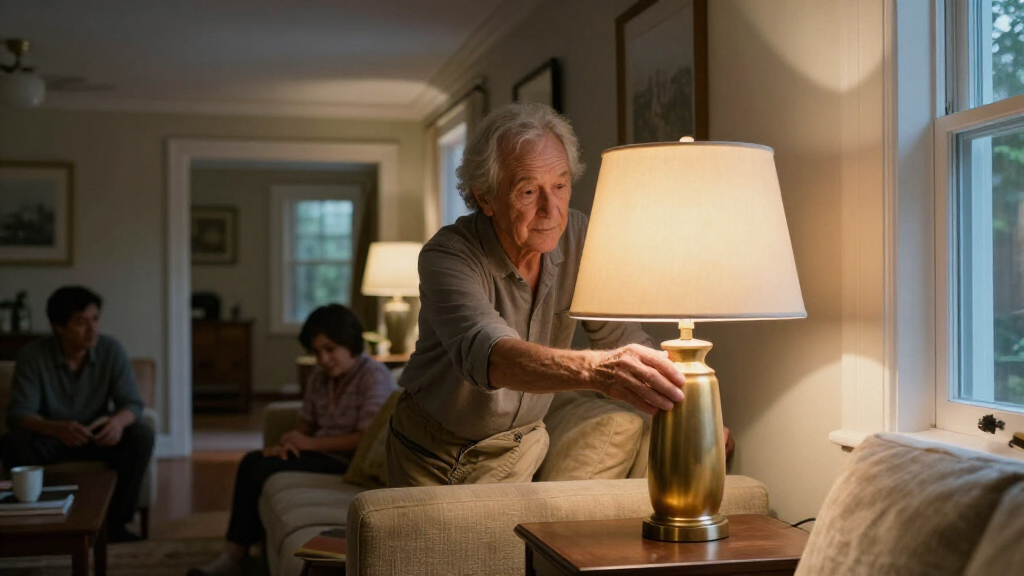
Color discrimination can matter during routine tasks, including reading product labels, sorting medication, judging food, and choosing clothing. The research team’s leader, Qi Dai of Fudan University, said lighting designed with age-related vision changes in mind could support older adults doing these activities and could be considered for homes or care facilities.
The design goal is not simply to make light appear different. The researchers say the selected spectra met conventional requirements for white-light chromaticity and color rendering, which could help keep familiar objects looking natural to people with typical color vision. That may be relevant in rooms used by people of different ages. The volunteer study, however, tested a controlled color-sorting task, not independence, safety, medication accuracy, or other real-world outcomes.
Products Worth Considering

Philips Hue Large Smart Light Tube, Black – White and Color Ambiance LED Color-Changing Light – 1 Pack

Philips Hue Festavia Globe Outdoor String Lights, 32 Bulbs, 91 ft

Ring Outdoor Cam 4K Plus Battery Security Camera, 3-Pack, White
As an affiliate, we earn on qualifying purchases.
From Vision Model to Lighting
The study addresses a limitation in conventional lighting assessment: typical color-quality measures represent human vision but, according to the researchers, do not account for age-related shifts in sensitivity caused by lens yellowing. The new model connects those changes to the spectrum of a light source and the colors of objects under it, allowing researchers to compare candidate white-light designs before testing them with people.
The study, titled “Enhancing color discrimination in older adults through age-adaptive spectral optimization of lighting,” was published in the Optics Express journal. Its authors are affiliated with Fudan University and OPPLE Lighting. The findings are an early test of using the model to select lighting spectra, rather than evidence that a particular commercial product is already available or effective across settings.
“As people age, the lens inside the eye gradually yellows and absorbs more short-wavelength light, which can make similar colors harder to discriminate.”
— Qi Dai, research team leader at Fudan University
Questions Before Wider Use
The reported human test involved 34 participants aged 70 and older and one type of color-sorting task. The source does not provide evidence from longer-term use in homes, care facilities, or other everyday environments. It also does not establish how the spectra perform at other common illuminance levels and color temperatures, or how younger people and other age groups perceive them.
The researchers say further studies should test the approach in everyday settings and include a wider range of ages, including younger users who may share spaces with older adults. The report also does not give details about the size of the observed performance gains on the sorting test, or whether the benefits extend to particular visual tasks. Those points limit conclusions about the likely effect of products based on the model.
Further Testing and Product Work
OPPLE Lighting is working to translate the findings into practical lighting products, according to the report. The company has not announced a product launch date or provided specifications for a commercial light based on the tested spectra.
The researchers call for additional evaluation under everyday conditions, at other commonly used brightness levels and color temperatures, and with participants across a broader age range. Dai also said the approach might be adapted to model how displays appear to older viewers or to groups with known differences in spectral sensitivity, but that would require separate modeling and human testing. No timeline for those studies was given.
Key Questions
What does the new eye model account for?
It estimates color discrimination using the light spectrum, the wavelengths reflected by objects, and age-adjusted sensitivity in the eye’s three cone types. It includes the effect of age-related lens yellowing, which absorbs more short-wavelength light.
Did the optimized lighting improve performance in people?
In a test of 34 adults aged 70 and older, both P1 and P2 lighting improved color-sorting performance compared with an LED-simulated daylight reference. The study tested a specific task under controlled conditions; broader everyday benefits have not been established.
What do the reported 49% and 36% figures mean?
They are model predictions for a hypothetical 85-year-old observer: P1 was predicted to recover about 49% of age-related loss in color discrimination and P2 about 36%. They are not percentages measured in the volunteer test.
Are these lighting products available now?
The report says OPPLE Lighting is working toward practical products, but gives no launch date or product details. Further testing is also needed before wider adoption can be evaluated.
Source: rss